M is for Moldova

When the former Soviet Union broke apart, the small country of Moldova was one of many that emerged from its ruins. Many pundits expected it wouldn’t last, that it would be absorbed by its neighbor to the west, Romania, as part of a grand reconstruction of what had been the country of Romania before the end of World War II. But on the ground, Moldova looked very different from Romania.

While all of what makes up modern day Moldova was once part of Romania, the language continued to be written in Cyrillic script in Moldova, in contrast to the adoption of the Latin alphabet in Romania back in the 19th century. The switch from Cyrillic to Latin alphabets in Moldova occurred in the last decade of the 20th century, more than 100 years later.

By the time I arrived in Moldova in 1992, the street signs had all been replaced to display the names in the Latin alphabet, but the transformation was not yet complete. The ambassador at the US embassy in Chisinau spoke Romania, not Russian. The political/economic officer spoke Russian, not Romanian. They attended a concert together where the program handed to all attendees was in Moldovan in Cyrillic script. The Russian speaker “read” the words aloud for the Romanian speaker to translate into English, the only way either of them could understand the program.

After World War II, the Soviets moved ethnic Russians into positions of importance in the Moldovan capital to run the banks, factories, and schools. This further diminished the role of the Romanian language, which by the time of independence was used primarily on the collective farms. Since Russian was the language taught in the schools, many people who spoke Romanian only did so at home. The version they spoke often made them sound like peasants, not professionals.

Yet in 1989 the state language law declared that Moldovan citizens have the right to choose Russian or Moldovan when doing business with the government. A deadline in the early 1990s was specified. Educated Romanian speakers had no difficulty meeting this requirement.  The deadline has been indefinitely postponed because of the large number of Russian speakers who cannot speak Moldovan.

The embassy had a difficult time finding Romanian speakers in Moldova who also spoke English. The Romanian speakers often spoke French or Spanish in addition to Russian. As a result, we had to recruit staff members who were at least trilingual–Russian, Romanian, and English.

A British comedy writer, Tony Hawks, wrote a book about his effort to win a bet that he could play and beat all the members of the Moldovan national football team at tennis. At stake–the loser would have to strip naked and sing the Moldovan national anthem on Balham High Road in London. You don’t need to know anything about Moldova or tennis to enjoy the book. If you read it, I predict you will, like Tony, agree that Moldovans are the friendliest people in the world.

L is for Lake Winnibigoshish

I thought I was too old for family vacations. I wanted to stay home, alone, while my parents took my five siblings. Dad wouldn’t say where we were going. He had never done that before–not told us.

But Mom insisted I not stay home alone. I don’t think she thought I was going to do something stupid–I wouldn’t have dared do anything I knew would make Mom and Dad angry. But to me it was a matter of whether or not they trusted me. I would turn 16 in the fall. I had been babysitting for my brothers and sister for six years. Surely I could take care of myself for a few days.

But Mom insisted.

Somehow we squeezed all eight of us into the car. Mom and Dad and my youngest brothers, the twins, in the front seat. The rest of us kids–all four of us–filled the back seat. There was no room to spread out. We were shoulder to shoulder, me at one end, sulking.

Every summer Mom and Dad took us on a camping vacation. It was the only way to afford putting up two adults and six kids overnight for a week at a time. Because we filled the seats, Dad built a box for the car top carrier to stow the tent, stakes, camp stove, and other items that could survive both rain and sun beating down on them. After the first trip, he modified the front of the box so that it slanted towards the back, to improve its aerodynamic qualities.  A single-wheel trailer held whatever clothes we needed. Food–prepared at least a week in advance and much of it frozen to keep from spoiling–stuffed in freezer boxes and thermos containers filled the trunk.

We almost never went the same place twice. And that’s why I was sulking. We had already made a trip to Lake Winnibigoshish, Lake Winnie for short, at a time when my mom’s sister’s family was also there. That meant I was able to spend my time with my cousin Lois instead of my younger siblings. Lois’s parents and a couple of their neighbors had bought an old school bus and transformed it into a camping van. The families that shared the ownership also shared the use, one family at a time. But even with those constraints, many times the bus was not used. All the owners were farmers who didn’t have the luxury of being able to pick any week to go off fishing. The cows and crops needed tending on their own schedule.

That first week at Lake Winnie, Lois and I also spent time with Dale, the son of the family who owned the resort where we rented camp sites by the week. Another teenaged boy worked at the resort, too. In the evenings, the four of us played cards in the A-frame building that served as the office as well as the summer home of the owners.

I wanted to go back to Lake Winnie. I told Dad that’s what I wanted. But Dad wouldn’t tell us what his plans were. The direction we headed out and the highway our trip started on weren’t clues either, unless we headed west into North Dakota, which was not a destination but rather just a state we had to get through on our way to somewhere else.

Dad headed east and then north. I’m sure the boys–two in the front seat and two in the back–found some excuse for poking one another, provoking a response to which “he started it” could be declared. And still I sulked.

An hour passed and still Dad kept driving. We were deep into Minnesota lake country by this time. With more than 10,000 lakes in the state, I still didn’t know where we would end up. Dad could turn off the highway at any time. But he kept driving.

Another half hour passed before Dad headed off the State highway down a county road. At that point, things began to look familiar. We had been here before. And it wasn’t long ago. Dad had turned down the drive leading to the Lake Winnie camping area we had been at earlier that summer.

I smiled. Dad smiled. Mom smiled. I may even have thanked Dad. I hope I did.

K is for Keren

Lisa, a teacher from Texas at the Asmara International Community School, introduced me to Keren, Eritrea. Or perhaps it was Keren that introduced me to Lisa. It happened in the Keren Public Library.

Once a month, Lisa and her daughter went to the Keren Public Library where the US embassy had set up an American Corner. These spaces in public places exist in towns too small for an American consulate, where information about the United States is made available for the local population. Often a computer terminal connected to the Internet is the centerpiece. No American staff members work at American Corners. Instead, a local staff member from the place, often a library or a university, agrees to assist those visiting the American Corner find information. In many American Corners, discussion or cultural programs are hosted.

Maryam Deira Chapel
St. Maryam Deari Chapel

Keren is the second largest city in Eritrea, situated within 60 miles from Asmara. It was the site of many battles during World War II and the Eritrean War of Independence. One attraction in Keren, St. Maryam Deari chapel, located inside a beobab tree, marks the site where Italian soldiers hid during a battle with the British in 1941. The tree was hit, and the hole in the tree can still be seen, but the soldiers survived.

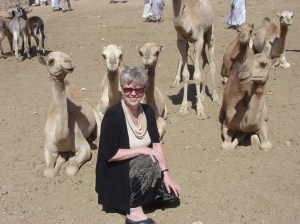
Sandra at the camel market
Sandra at the Keren camel market

Another attraction, at least for me, is the camel market, held each Monday.

But my fondest memories of Keren are of Lisa and her kids at the Keren Public Library. One Saturday each month, an embassy driver picked up Lisa and her daughter for the trip to Keren. Lisa invited me to come along. We got started late that Saturday so I asked Lisa what would happen if we didn’t arrive on time. I worried that the children might leave if we weren’t there on time. She assured me that nothing would happen until we arrived. She, it turned out, was the program in Keren. The children all waited for her. And when it was time for her to leave, they stayed at her side, holding her hands, her arms, her shirt, attempts to keep her there longer.

Armed with a cassette tape player, cassettes of songs used in American early childhood education programs, children’s books, and posters containing enlarged drawings from some of the books, Lisa performed with a group of 20 kids ranging in age from four to 14. She called it a class. I felt it was much more.

She got them all up on their feet to sing and dance along with the songs. Even the older ones enthusiastically joined in as they sang “I’m a little teapot, short and stout . . .” They all placed on hand on a hip with “Here’s my handle . . .” and raised the other hand with “And here’s my spout.” After they sang the song, Lisa asked questions about teapots, tea, and anything else the children’s answers raised.

My favorite part of the program involved Lisa handing out posters of the drawings from the book Brown Bear, Brown Bear, What Do  You See? by Bill Martin Jr. and Eric Carle. The children with the posters lined up in the order the animals appear in the book, and they held up their posters for the rest of the children to see when Lisa mentioned their animal as she read the book.

After Lisa finished reading the book to them, the children with the posters recited the book pages themselves. All of the children recited the first part of each page, “Brown Bear, Brown Bear, what do you see?” The child holding the drawing of the brown bear then answered, “I see a [black bird] looking at me.” And so it went, not necessarily in the order of the pages in the book. The variation ensured that every child in the room listened carefully to know which animal they next would ask the question. A second set of children then took their places and repeated the exercise.

As I watched the performance, I conjured up a continuation of the lesson for Lisa, one where the students might have to give up the rhyme of “see” and “me” by replacing “you” with “he,” “she,” or “we” in the question and then replacing “me” with “him,” “her,” or “us,” as appropriate.

On the Saturdays Lisa wasn’t in Keren, she conducted two of the same classes in Asmara at the American Cultural Center. She repeated the class each Saturday so that all of the more than 100 children who wanted to take part could attend one.

Lisa’s program wasn’t something the US embassy asked her to create. It was an idea based on her passion for sharing language and learning with more than just the two dozen children in her elementary school classroom at the Asmara International Community School. She started out hoping to establish a children’s story hour like in libraries in Texas she had brought her daughter to before her daughter reached school age. She asked for permission to invite the children of US embassy employees. On that first day, a dozen children arrived. The next week, she was surrounded by children who lived in the neighborhood who asked if they, too, could join the class.

Reading to children and encouraging them to learn to speak English was not Lisa’s only passion in Asmara. She noticed many children in her own neighborhood did not have shoes. Lisa approached the owner of a shoe store in Asmara and arranged to pay him for shoes in exchange for a coupon she printed and gave to children whenever she saw one without shoes. Each month she received a bill for the number of pairs of shoes she had given coupons for.

Lisa’s willingness to immerse herself into the lives of the people, especially of the children, of Eritrea inspired me to take the time to talk with a few boys I met on the street in downtown Asmara a few weeks later, a conversation that led to my sponsorship of a neighborhood soccer team, documented in E is for Eritrea.

Thank you, Lisa.

J is for Japan

A plain wooden trunk in the basement of the house of my childhood was off limits. Its contents included my parents’ mementos from the days before we children arrived. The kewpie doll my dad won for my mom at the fair, some dish towels mom had embroidered for her hope chest, comic books that Dad must have picked up to read on long sea voyages when he served in the U.S. Merchant Marines.

It also included items associated with far away places, places I was determined to see. Occasionally, while we kids were in the basement, Mom or Dad would open it and pull things out: a grass skirt from the Philippines; a silk hula skirt with skimpy bra top from Hawaii; a gaudy, child-sized, yellow kimono with bright red, embroidered dragons facing one another at chest height from Japan.

Dad brought these pieces of exotica to Minnesota from ports he visited during and after World War II. The most important ones for me were from Japan: a silk kimono and a fan. The kimono — not the tawdry yellow one — was elegant, purple from the neck and shoulders down with a scene of white cranes flying among the clouds above snow-covered mountain tops from the hem at the bottom up to the knees. The kimono was lined with the softest red silk, softer than any fabric I could remember touching my skin.

The fan’s two wooden handles were a shade of neither red nor brown, but both at the same time. When opened, the semi-circular fan, silk on one side with a stiffer fabric on the other, to help it keep its shape, displayed a mountain in the distance with graceful tree branches with white blossoms in the foreground.

I loved to put on the kimono, even though the two feet with the mountain scene spilled around my feet on the floor. I struggled to open the fan correctly. I didn’t want to tear the delicate, painted paper. I needed both hands and had to remind myself which way to move the handles to separate them and to reveal the fan.

These two items, more than anything else, opened a door to my curiosity that demanded I learn as much as possible about Japan and the people who lived there.

Japan was my first love, long before boys ever began looking interesting.

When I started school, I discovered there were books in its library about Japan. I read them all, starting with the bottom shelf (for those reading at the first-grade level) and then continuing up the graded shelves. By the third grade, I had finished all the books, up through those on the sixth-grade level shelf. I turned to books about other countries, such as nearby China, but they didn’t hold my interest. Learning about Japan had become a dream.

Someone else in my Minnesota hometown also had a dream.  Miss Ingram, our school music teacher, dreamed of igniting passion for music among her students.  Each year she wrote and organized two musical productions, operettas, one for the third and fourth graders and one for the fifth and sixth graders.

In sixth grade, the title of our operetta was “Around the World in 60 Minutes.” Two students led the audience on a tour of countries represented by songs the rest of us sang. One of my pieces was the Gilbert and Sullivan tune “Three Little Girls From School Are We” from The Mikado.

I will never forget wearing the purple silk kimono from the basement trunk in that production.  And my infatuation with Japan got an even bigger boost when Miss Ingram taught the three of us how to open our fans one-handed with the flick of the wrist.  By then, my dream had grown from learning as much as possible about Japan to wanting to visit Japan.

In the following years, my dream of visiting Japan took a back seat to the shorter-term goals of finding and keeping friends, passing tests, getting boys to notice me, and figuring out how I could escape the small town I felt I was stuck in.  Eventually I did make it out of the Midwest, all the way to San Francisco. I enrolled at San Francisco State University and completed their Masters of Arts program in Teaching English as a Second Language (ESL).

In my first course, the instructor demonstrated two approaches to teaching a foreign language. Her sample language was Japanese. And that switched my dream of visiting Japan back on. Now I wanted to live and work there.

But there weren’t many jobs in Japan when I completed my training. Instead, Iran was the place with jobs open to Americans. I signed a two-year contract and headed there with 10 other American ESL teachers.

At the end of my contract, I finally made it to Japan, the final stop in my nearly three-week, multi-country trip home, through India, Thailand, Indonesia, Korea, and finally, four days in Tokyo.  Four days when I smiled so much, my jaw ached by the end of the day. I was in Japan!

I went to a Japanese tea ceremony. I climbed to the top of the Tokyo Tower. I saw a Kabuki theatre production. I went to a nightclub. I wandered through a park with streams, bridges, flowers, and trees aesthetically arranged to bring calmness to those visiting.

I bought my very own blue and white silk kimono, though the prices in Tokyo were so very high I couldn’t afford one to compete with the beauty and elegance of the purple one. Mine was only knee-length and had only geometric designs along the bottom. I bought trinkets to bring home for family members and watched in wonder as the smiling and polite salespeople wrapped them in decorative paper as if the packages were gifts to me.

Those four days in Tokyo realized enough of my dream, but opened up my hopes for seeing more of the world. I also drew two important lessons from the experience, one immediately and one that only came years later.

First, I learned that working steadily to accomplish a goal makes the problems and disappointments, both small and large, shrink to insignificance. I never give up.

Second, years later my parents, my husband, and I were crossing the mall in Washington, DC.  By then, I was working for the U.S. Department of State as a Foreign Service Officer and this was my parents’ first visit.

While we waited at an intersection for the light to change, a middle-aged Japanese man approached my father to ask for directions.  After pointing the way for him, my father joined the three of us. Dad was pensive and finally commented that fifty years earlier, while he was in the Pacific in the Merchant Marines, he would never have imagined that he would one day be speaking to someone from Japan in the capital of our country.

Hearing that comment made me realize how generous and understanding my parents were because they never discouraged me from my dream of going to Japan. My dream began so shortly after the end of World War II, yet neither of my parents tried to dissuade me from my interest in the country of our former enemy.

Instead, they encouraged the spark of interest with the hope that it would lead to other interests and a love for learning. They were right.

The purple, silk kimono was the spark. It ignited my curiosity which led to my nearly thirty-year exploration as a resident, not a tourist, of several foreign countries so small you’ve probably never heard of them.

I is for Iran

I loved it and I hated it on the same day every day for 882 days. It was Iran, and my love-hate relationship began on April 2, 1975, at the start of what I referred to as the world’s most elaborate April Fool’s gag.

Two years before, I hadn’t thought such an adventure possible. At that time, I lived in Berkeley, California, with my husband and our cat named Kitty. I planned to enroll in graduate school in the winter. Without warning my husband told me he thought we should divorce. It was simple and amicable: we had no property to split, no home to sell, no children. But simple doesn’t mean painless.

For most of the first year in grad school, I had nightmares, dreaming that I either chased my husband or was chased by him. My subconscious wanted to hit him, to hurt him, but I never caught him. And I didn’t want to be hurt any more, though why I thought he was trying to do so remains a mystery of the dream state. I woke up exhausted. Then, for months I had no dreams at all.

Toward the end of year two, he appeared in a dream, a guest at a party. I introduced him to other partygoers, referring to him as a friend. No chase scenes, no anxieties. The difference was so pronounced I wrote him a letter describing the dream. He wrote back, admitting that he hadn’t handled suggesting our separation well, asking for forgiveness, though not reconciliation.

Two weeks later, the University of Southern California offered me a job in Iran. The timing was right. Painful as it was, I knew that if we hadn’t divorced, I wouldn’t be at the beginning of this adventure. A door had to close for me to see the open door next to it.

***

April 2 began in London where the New York to Tehran Iran Air flight picked up a small number of passengers for the final leg. Passengers originating from New York filled most of the seats. Ten of us from USC—nine teachers and the man who hired us, Bill, the director of USC’s American Language Institute—joined them. We stood out from the rest. We were taller. Our skin, lighter. We were foreigners.

I hope there is space in the overhead compartment for my violin. There had been no problem on the flight from Los Angeles to London, but that plane was much bigger: two seats on each side of the plane with a center section of five seats across. So large, I could imagine I was on a train or a boat, not a plane, as I wandered up and down the aisles.

This plane had three seats on either side of the aisle, the size I was used to for domestic flights from California, my adopted home, to Minnesota, my birthplace. The overhead bins reduced headroom, making the plane feel even smaller. The thought of spending six hours shoulder-to-shoulder, elbow-to-elbow, and knee-to-knee on such a small plane brought on anxiety, especially since my boarding pass was for the middle seat. There was nowhere to escape the crowding, like my 4,000 member hometown church’s pews at a Christmas or Easter service.

“Hey, Roger,” Annie said. “Is this our row? I’ve been counting them.” She pointed to the strange symbol under the overhead bins and held up her boarding pass.

Annie and I had been roommates in San Francisco. She wanted to teach in Spain. But my offer came through first, and she traded being faced with finding a new roommate and simultaneously looking for a job for a guaranteed position just a bit east of her goal.

“Yeah, this is row 22,” Roger said. He had been in the Peace Corps in Ahwaz, Iran, ten years before, the only one of us who had lived in Iran. “They use Hindi numerals in Iran. The 1 and 9 look similar to our numbers. The rest are like chicken scratches. You’ll get used to them.”

Annie squeezed her way to the window seat. I pushed and rearranged the bags and bundles already in the overhead compartment above our seats until my violin case fit and then settled in the center seat. Roger took the aisle seat, to keep us protected from intrusion by prying eyes and hands across the aisle, he said.

Ahead of us, Bob and his wife, Nancy, stood in the aisle next to row 21. Already in that row, I saw a man wearing a heavy winter jacket in the window seat. Boxes tied with twine and fabric bundles filled the area under the seat in front of him as well as under the middle and aisle seats. An additional case rested on each of the two otherwise empty seats, as though they marked them as saved for companions. But Bob and Nancy’s boarding passes bore 21B and 21C.

“Excuse me, sir,” said Bob to the man in 21A. “Are these your suitcases?”

“Sorry, no Eengleesi.”

Bob looked up, noticed a woman in uniform with the Iran Air logo on her hat, and motioned to her. Pointing to the items on seats 21B and 21C, Bob chose his words diplomatically, not wanting a confrontation, simply pointing out the problem, just as any other Midwesterner would do. “These spaces are already full,” he said. “Where can we put our carry-on?”

“You shouldn’t have brought so much with you,” the attendant replied and then broke away to continue moving to the front of the plane. Nancy’s mouth dropped open.

“Welcome to Iran,” said Roger. “You’ll get used to it.”

“I have Valium,” offered Annie. She and I had laughed when her doctor handed over a container with thirty 1-mg tablets of the anxiety-reducing medication in response to her request for something to deal with motion sickness. She had expected him to give her two or three tablets of Dramamine. Before we left, Annie counted out fifteen tablets for me and kept fifteen for herself. We never dreamed we would take them all. But by the time I left Iran 822 days later, I had replaced my fifteen tablets many times. No prescription required. Even 10-mg strength.

“Let me help,” said Roger as he got out of his seat and took one of Nancy’s bags. He squeezed it into an overhead bin a few rows behind us. Bob did the same with another bag several rows in front. The man in the window seat picked up the parcels on the middle and aisle seat and placed them on his lap, apparently prepared to hold them for the entire flight.

“You better take the middle seat,” Roger said to Nancy. “You can stuff your purse between you and the guy next to you. It’s a better option than the aisle seat. No one will bother Bob when walking down the aisle.”

Once all passengers were seated, a male flight attendant read the standard safety instructions, first in Farsi and then in English. During the announcement, I watched a second male attendant across the aisle lean back as he lowered both his seat and the seat-back tray, and lit up a cigarette. The final statement of the standard instructions also differed from what we expected: “Let us know if there is anything we can do to make your flight comfortable.”

“Don’t they usually say ‘more comfortable’?” I asked Annie and Roger.

“Welcome to Iran,” Roger said one more time.

Ten hours after leaving London, we arrived in Tehran after a stop in Ahwaz to clear customs and immigration. Bill would return to LA once USC sent someone as director of the Iran program. Annie and I were the last two teachers Bill hired, just two weeks before we left. I was single and, at 26, the youngest of the group. I was also the most naïve.

The above is the opening to the draft of my first memoir with the working title Stuck in Stage Two: A Memoir of Cross-Cultural Confrontations and Misunderstandings.

H is for Hungary

Five days in Budapest, Hungary, in October 2000: that’s all the time I spent there. On the Thursday of that week, October 12, while I was attending a conference on travel issues in Budapest, the USS Cole was attacked in Aden Harbor on the southern coast of Yemen.

What’s the connection? Why does that matter?

If it were not for the travel conference, I would have been in Yemen, possibly even in Aden, on that day. Two of my colleagues were in Aden, spending the long weekend coinciding with the US embassy’s observation of Columbus Day.

I have always felt the presence of a guardian angel in my life. Even when things go wrong, there is a way that true disaster is averted. For example, the engine of my 1969 VW bug blew out a piston the summer I drove it from San Francisco to my home town, a distance of more than 2000 miles, but the piston didn’t blow until I was just two miles from home.

And then in October 2000, my guardian angel kept me out of the danger brought by suicide bombers in Aden where 17 American sailors were killed and another 39 were injured. By the time I returned to Sana’a, my colleagues were exhausted. Everything had changed.

But because I was not in town when the suicide attack occurred, I was refreshed, as though simply being in proximity to Hungary’s famous wellness spas was enough.

Book Review: Deadly Little Secrets

Five StarsdeadlylittlesecretsIn Loren Zahn’s second Theo Hunter mystery, Deadly Little Secrets, her protagonist, sometimes freelance journalist Theodosia Hunter, agrees to help out an old flame, now a Catholic chaplain, Tony Machado. Father John Fairbanks, a priest, teacher, and coach years ago at St. Augustine’s, a private Catholic high school when Tony attended, was found murdered, with the word “rapist” written on the wall of the confessional. Convinced the word was an attempt to falsely smear Father John’s reputation, Tony asked Theo to contact a few of his classmates to get testimonials to Father John’s good character to include in his personal profile with the church.

Knowing Theo’s investigative instincts might take over, Tony warns that she stick to getting the testimonials, not try to solve Father John’s murder. She tries to follow Tony’s instructions, but people keep getting killed. Theo recognizes the connections that mean she must dig deeper in order not to become a victim herself.

Deadly Little Secrets is a well-written thriller with just enough tension and plot twists to keep the reader turning pages. Zahn introduces us to believable characters with flaws, imperfections, and aspirations that allow us to laugh along with them and care about them. I look forward to getting to know them better in other Theo Hunter novels.

Genre: Mystery, Women Sleuths
Print Length: 426 pages
Publication Date: September 22, 2015
Sold by: Amazon Digital Services LLC

F is for Fargo

I arrived in Fargo by way of St. Luke’s Hospital, my birthplace. While I never lived in Fargo–my family lived across the Red River of the North in Moorhead, Minnesota–there is no denying that Fargo had a big impact on my life. And initially, all I wanted was to get away from it.

Fargo may be the largest city between Minneapolis and the West Coast, but it was still too small to be called a big city. And I knew I wanted to live in a big city.

My first foray outside of the reach of Fargo was the summer of 1968 when I spent seven weeks living in Union City, New Jersey, while I volunteered at a church in Weehawken, New Jersey, in an arts, crafts, and recreation program. Each weekend I traveled to the biggest of the big cities–New York City. And that’s where I wanted to be.

But the summer ended, I returned to Minnesota, and I continued to dream of ways to get out.

At the end of college, I headed as far as I could get from Fargo without having to get onto a plane or a ship–Berkeley, California. A couple of years later, I traveled even further west to San Francisco. And that’s the big city I chose for the rest of my life.

But that didn’t work.

Instead, I’ve been traveling ever since, spending a few months to a few years in different countries, on different continents, in different cities.

Still, there is no denying that I come from Fargo. If it weren’t for the cold and snow of winters, I’d probably be back there now. Over the years, Fargo got a little bigger. It got a little more cosmopolitan. It got more diverse. And I got a little older so that I don’t need so much variety. And Fargo is still one of the best places in the world to come from. People in Fargo trust one another and anyone else who comes to town. And that just plain feels good. I probably wouldn’t have been so successful at moving around from place to place and culture to culture if I hadn’t had the solid grounding that just comes with living in Fargo and Moorhead.

But don’t take my word for it. Marc de Celle brought his family to Fargo from Phoenix and found so many examples of how people in Fargo made him feel at home that he wrote a book about it: How Fargo of You