Book Review: A Paris Apartment

aparisapartmentA mystery inside a mystery. April Vogt, Four starsContinental furniture specialist with Sotheby’s, gets the opportunity of a lifetime when the Paris office requests her assistance to assess the contents of a Paris apartment that had been closed for 70 years. Full of incredible furniture finds, as well as an unknown painting by Giovanni Boldini, the contents promise an exceptional auction. Then April finds journal entries of the woman who walked away from the apartment 70 years ago, Marthe de Florian, a 19th-century courtesan whose life intersected with many of the turn of the 19th-to-20th century Parisian personalities and her estimates of the potential auction proceeds skyrockets. But she can’t convince those in charge to follow her suggestions.

In addition, April is uncertain of the state of her marriage and is attracted to the lawyer for the apartment’s beneficiary who plays a key role in getting access to all the journal entries as well as to the woman who wants to sell the contents.

Gable’s story is full of all the key plot twists and turns authors are instructed to include, on two levels: April’s life as it plays out in the novel as well as Marthe de Florian’s in the journal entries. Maddeningly for April, the journal pages provide an incomplete picture of Marthe, leaving her convinced she needs to learn more in order to persuade her bosses to set up a special auction of all the pieces instead of breaking up the collection to add individual pieces to several general auctions. Or does she simply want to satisfy her own curiosity?

Gable’s story is intriguing, all the more so because its premise is real. The real life Marthe de Florian walked away from her Paris apartment at the beginning of World War II where the furniture and the Boldini portrait remained out of sight for 70 years. Love letters to Marthe were also found in the apartment. Gable invents a few characters, a relationship or two, but remained true to the bones of history.

While I enjoyed the characters, some of the relationship contortions that Gable has April put herself through diminished the entertainment, the reason I assigned only four stars.

Insecure Writer’s Support Group–My First Post

Insecure Writers Support Group BadgeIt’s Insecure Writer’s Support Group Wednesday. I signed up last week when I learned of the group and its requirement to post each first Wednesday of the month. So here’s my challenge for the week.

I know I have to prepare a synopsis of my memoir. I know I should prepare an outline. I know these things, but I’m having trouble getting started.

One reason for the problem is that preparing an outline suggests I have control over the events to include in it. But the events as they happened don’t fit so neatly into the hero’s journey or the 15 essential plot points.

I can reorganize the scenes to fit the desired order, but then the story wouldn’t be as it happened. It wouldn’t be “true.”

Is it appropriate to be creative with the timeline for a memoir?


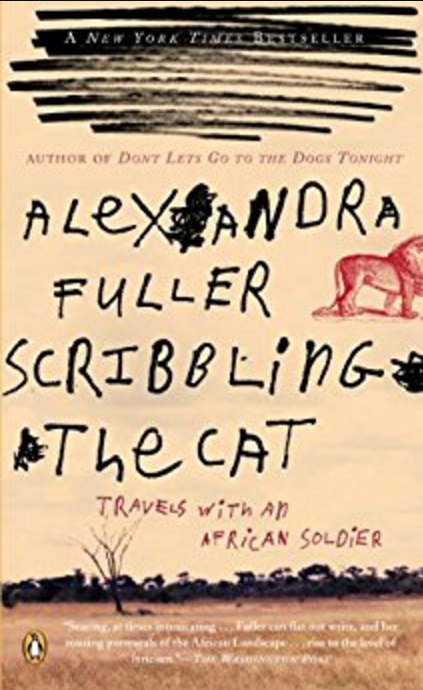
Book Review: Scribbling the Cat

scribblingthecat“The windows of the pickup were rolled down because we, in Five Starscommon with everyone else in this part of the world, were jealous of every drop of fuel we spent. And, under these circumstances, air-conditioning (like the exorcism of war memories and the act of writing about it) was an unpardonable self-indulgence. K had gone quiet and the muscle at the back of his jaw had begun to quiver. Air-conditioning ices memories with its blandness, but with the windows wound down the past came rushing back at K. ‘Do you smell that?’ he asked me more than once, looking at me as if expecting to see the same war-shocked look on my face as he wore on his own. I nodded. But what I was smelling was not what K was smelling. I was smelling now, he was smelling memories.”

In Scribbling the Cat: Travels with an African Soldier Alexandra Fuller tells the story of her return to Zambia in order to travel with K, a soldier who fought in the many wars of independence in East Africa in a search to make sense of what the war had done to them both. Still a child during the wars of independence that turned Rhodesia into Zimbabwe, Northern Rhodesia into Zambia, and freed Mozambique from the Portuguese, Fuller experienced it as a time when both her parents were defenders of colonial way of life. In her first memoir, Don’t Let’s Go to the Dogs Tonight, she recalls being left behind with her sister and mother as her father heads off in camouflage and a blackened face so that he won’t be visible. Fuller the child wants to yell out to him in warning as she watches him walk down the drive leading to their farm that she can still see him, that he must watch out. She also sits at her mother’s feet during her mother’s periods of assignment at the map of lights set up to give white farmers a warning system if attacked. If one of the lights came on, a call to arms would go out to defenders to race to the farm under attack.

Years later, Fuller, now married and mother of two children, returns from her Wyoming home to visit her parents in Zambia. She meets K, a soldier who is still battling demons unleashed during his time as a soldier in the RLI, Rhodesian Light Infantry.

“Because it is the land that grew me, and because they are my people, I sometimes forget to be astonished by Africans.”

Fuller begins her narrative with the lines above. K astonished her because he was still in Africa after years of fighting against the native Africans who were fighting to take possession of the land. K has lost his farm, his son, and his wife. But K has found God. He has turned his life over to God, asking God for guidance every day. K asks God if He has sent Fuller to be with him.

Fuller admits she and K were on the wrong side in the fight. And yet her parents remained. K remained. And she returns again and again, feeling African more than any other nationality in spite of her American husband and Wyoming home. She invites K to return with her to Mozambique, where K spent most of his time fighting to retain possession of African land, in the hopes that she can help him find reconciliation and she can find understanding.

“You can’t rewind war. It spools on, and on, and on. Looping and jumping, distorted and cracked with age, and the stories contract until only the nuggets of hatred remain and no one can even remember, or imagine, why the war was organized in the first place.”

In the end there is no reconciliation, no understanding. There is only the story of “what happens when you stand on tiptoe and look too hard into your own past and into the things that make us war-wounded the fragile, haunted, powerful men-women that we are.”

This is a naked story of warts and wounds and victims of war. Fuller opens up the door to let the reader see her Africa, an Africa she loves in spite of its terrors and dangers. She uses the language those she meets would use, unflattering in its references to black Africans, but without apology. She simply reports.

To any who choose to pick up her story, and I recommend doing so but not until after reading Don’t Let’s Go to the Dogs Tonight, be sure to turn to the back of the book to review the Glossary before diving into this story.

Book Review: Don’t Let’s Go to the Dogs Tonight

dontletsgotothedogstonightAlexandra Fuller’s first memoir covers her chilFive Starsdhood in Africa, including stints at boarding schools far from her parents, ending with her marriage to an American who brought her out of Africa and into another land.

Her parents were grounded in Africa, her mother by birth and her father by experience. Yet after the death of their second child, a boy, they chose England, perhaps to escape the threat of the Coming-Back Baby because they hadn’t buried their son far enough away from their Rhodesian home or perhaps to avoid the rising threat of violence in the increasingly independence-minded region. In the few years the family lived in England, Alexandra was born.

But success in England eluded them. In view of insurmountable debts, Fuller’s father returned to Rhodesia, and her mother brought the two girls, Vanessa the first born and Alexandra, back by ship to Cape Town and then by train to Rhodesia.

Fuller tells the naked story of her family’s successes and failures in England, several spots in Rhodesia (now Zimbabwe) including on the border with Mozambique, Malawi, and Northern Rhodesia (now Zambia), without judgment, as an objective participant, if that isn’t an oxymoron. There is no apology in the book. There is just the story, told with candor and compassion, with humor and hope. Fuller uses the language of her mother, not hiding her mother’s colonialist views of the Africans. But she also tells of the loss of two more children which bring her mother at least to the brink of a nervous breakdown. Since her parents’ life choices differ so widely from what most people would consider average, it is difficult to be certain how far from the Fuller-normal either parent ever drifted. In the end, her mother survived.

Fuller describes the Africa of her childhood down through the layers of dirt and muck under her feet with love. Learning how to recognize possible improvised explosive devices and how to handle a gun are normal elementary school requirements. When the girls go to sleep, they worry about terrorists hiding under their beds. Yet there is no judgment as she writes. This is Africa, she writes. And it is home.  We should all have such warm feelings of home.

Z is for Zambia

White Rhino by SarahDepper, on Flickr

I never wanted to go to Africa. I was sure of it. That is, until I went to Yemen, another place I never wanted to go.

But a good reason to go to Yemen came along. And I am so very pleased. I enjoyed Yemen so much more than I had expected (Y is for Yemen) that I realized I needed to give more consideration to other places I thought I didn’t want to go. Africa came immediately to mind.

I planned to retire from the Foreign Service once I had completed 20 years. Everything about the system was geared to encourage Foreign Service employees to leave after 20 years, except for the few who managed to be promoted into the Senior Foreign Service. I didn’t expect to reach that level, so I planned my life assuming I would retire in 2005.

In 2003, I actively sought as my final assignment an opportunity to see as much of Africa as possible in what I assumed would be my final two years: roving management officer. For my last two years, I would serve temporarily in whatever management positions the Bureau of African Affairs felt were most important to fill when the gap between leaving and arriving employees was long or when vacancies occurred unexpectedly, due to illness or other emergencies.

Plans have a way of being interrupted, especially when living overseas. Instead of spending two years in Africa as a roving management officer, I was only there for nine months. And that meant I only experienced three countries: Madagascar (A is for Antananarivo), Eritrea (E is for Eritrea; K is for Keren), and Zambia.

My stay in Zambia was the shortest: three weeks. Far too short. So I’m “extending” it through reading.

Zambia is the setting for a number of memoirs. Here’s one I just finished. Watch for my review of it soon. (A preview–I gave it five stars.)

(From Goodreads.com) “In Don’t Let’s Go to the Dogs Tonight, Alexandra Fuller remembers her African childhood with candor and sensitivity. Though it is a diary of an unruly life in an often inhospitable place, it is suffused with Fuller’s endearing ability to find laughter, even when there is little to celebrate. Fuller’s debut is unsentimental and unflinching but always captivating. In wry and sometimes hilarious prose, she stares down disaster and looks back with rage and love at the life of an extraordinary family in an extraordinary time.”

The following are now on my “Want to Read” list:

(from Goodreads.com) “When former journalist Adeline Loh could no longer endure the brain-deadening routine of work, she did what any sensible person would do: flee Malaysia with a paranoid vegetarian named Chan and go ambling in the lion-infested wilderness of southern Africa. However, upon arriving in Zambia, the bush virgins realised nothing from the Animal Planet documentaries had prepared them for survival in the savannah. With baboons, hippopotamuses and buffaloes conspiring to tear them into pieces, our addled heroines rattled along crater-pocked tracks, canoed through the crocodile-infested Zambezi River, flew over Victoria Falls on a little tricycle with wings, stalked incestuous rhinoceroses and peed amidst thorny shrubbery. And in more life-preserving moments, they pondered antimalarial druggies, sleazy hunters and muscle-bound native women while hoping to achieve their main goal—not to get eaten alive!

“In Peeing in the Bush, Loh recounts in candid prose her fun and engaging misadventures in Zambia with a rich mix of anecdotes, commentary and deft description.”

This one is in my hands, written by the same author as the one just finished so I am looking forward to starting it.

(from Goodreads.com) “When Alexandra Bo Fuller was in Zambia a few years ago visiting her parents, she asked her father about a nearby banana farmer who was known as being a tough bugger. Her father’s response was a warning to steer clear of him: Curiosity scribbled the cat, he told her. Nonetheless, Fuller began her strange friendship with the man she calls K, a white African and veteran of the Rhodesian War. A man of contradictions, K is battle-scarred and work-weathered, a born-again Christian and given to weeping for the failure of his romantic life and the burden of his memories. Driven by K’s memories of the war, they decide to enter the heart of darkness in the most literal way, by traveling from Zambia through Zimbabwe and Mozambique to visit the scenes of the war and to meet other veterans. The result is a remarkably unbiased and unsentimental glimpse of life in Africa.”

(from Goodreads.com) “It is 1972 and James and Katrina Martin set off for a well earned month of vacation from Zambia to South Africa and England. They return to find that James is to be offered an opportunity to start a new mine away from the Zambian Copperbelt, an opportunity that he takes. They travel to the Mtuga operation which is located just off the Great North Road in the Mkushi district of Zambia. The mine is sited on old workings from the 1920’s and is being re-opened as a surface mine. The Mkushi District is better known for its tobacco and maize farms and in the late 1970’s for the camps of the Zimbabwe People’s Revolutionary Army (ZIPRA), an organization that they will encounter a few times.

“Life is complicated when the Rhodesians close the border with Zambia and Zambia retaliates, potentially stranding all their new mining machinery outside the country. They must formulate a plan to get everything to the mine and the operation started on time and to budget. Things are further complicated by corporate politics and rivalries that create problems along the way.

“Although now married for almost three years, James and Katrina continue to discover each other and their romance and desire for one another is as strong as ever. They take every opportunity they can to be away and alone together in the more remote parts of Zambia.”

(from Goodreads.com) “1898, Tsavo River Kenya, the British Empire employs native workers to build a railroad. Construction comes to a violent halt when two maneless lions devour 140 workers in an extended feeding frenzy that would make headlines and history all over the world. Caputo’s Ghosts of Tsavo is a new quest for truth about the origins of these near-mythical animals and how they became predators of human flesh.”

You may recognize the lions as the titular characters in the 1995 movie, The Ghost and the Darkness. For the original book on which the fictionalized movie was based, see The Man-Eaters of Tsavo.

And there is also fiction.

(from Goodreads.com) “In A Cowrie of Hope Binwell Sinyangwe captures the rhythms of a people whose poverty has not diminished their dignity, where hope can only be accompanied by small acts of courage, and where friendship has not lost its value.”

Y is for Yemen

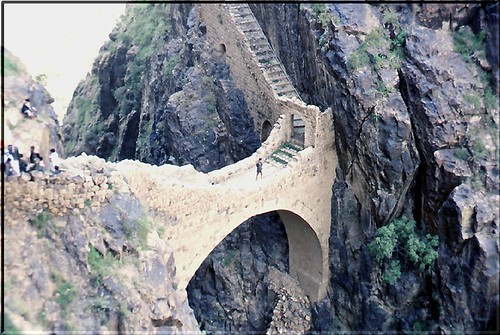
There is only one rule when driving in Yemen–basic rule #1–whoever is in front has the right-of-way. Rear-view and side-view mirrors are optional. Most Western men just can’t give up the driving habits of home, choosing instead to be driven crazy by the behavior of every Yemeni driver.

I, on the other hand, adjusted my driving habits, abandoning the need for my car to march within the lane markings. I rejoiced over the resulting un-choreographed dance other drivers and I performed on the streets of Sana’a. I have always preferred dancing over marching.

I drove every day during my year at the US embassy in Sana’a. All American staff except the ambassador lived a 20- to 45-minute drive from work.

Those who chose the direct route could usually make the trip in 20 minutes. But I enjoyed extending my trips by taking very seriously the suggestions from the Bureau of Diplomatic Security. I varied both my departure time and my route.

I made a game of it. No one could predict my route to work because I didn’t decide which way to go until I turned out of my driveway in the morning.

Here were the rules of my game. At each intersection,

  • If the first car I saw was black, I turned left;
  • If the first car I saw was white, I turned right;
  • If the first car I saw was any other color, I went straight ahead;
  • If the intersection was a T-junction, I made a turn in the same direction as my last turn.

Because Sana’a’s road system consists of concentric ring roads, it didn’t matter how I started out each morning; eventually I would end up on one of the ring roads and that meant that eventually I would end up at the embassy.Once I reached a ring road, I made my way to the embassy directly. Sometimes it took 20 minutes; sometimes it took an hour.

My two-door, Toyota RAV-4 had the tightest turning radius of any car I have ever driven. I never worried about getting stuck when my game took me down a sand and rock track at the end of a paved road. If continuing straight ahead didn’t look feasible, I turned around and headed back.

The RAV-4 was so small I could even take it down streets in the Old City, streets so narrow traffic could only go one way at a time. Of course, cars were not expected on them so no signs indicating the preferred direction could be found.

Late afternoon one day in Ramadan, when everyone in the Old City marketplace was doing last-minute shopping before sunset marked the time for breaking the day-long fast, I ended up on such a road, facing another car. A Yemeni man gently pressed in the side view mirrors of my car to narrow its silhouette slightly and then directed both me and the other driver to move inch by inch, sometimes backing up, sometimes moving forward, until we passed one another with only millimeters separating us. His directing task complete, the Yemeni man turned away from me and continued down the street on foot.

One morning I noticed a black car behind me. I was half way to the office, still following my rules, when I realized the car behind me had made each turn after me. I picked up my radio and called into the embassy to report that I thought someone was following me. After a delay of about a minute, the Defense Attache came on the radio to assure me that the car was from the Yemeni Interior Ministry and was there for my protection.

Apparently the Ministry of Interior had been following each of us to work for months, but that was the only time I noticed. I never decided whether that was reassuring.

Since I never left the embassy for home at the same time any two days in a row, I was already unpredictable. I chose one of three routes home and usually stayed on that path until I got home.

But one evening I was distracted–I had to attend a representational event later but didn’t want to. As I made my way into a traffic circle, a truck on my left brushed up against my car. I pulled over and parked right away, but the truck driver kept going. I must have been quite a sight as I got out of my car and ran down the street in my stylish, but oh so short, dress and high heels yelling at the driver and slapping the side of his trust to get him to stop. I considered him to have been driving recklessly and wanted to be sure there was a report of the accident.

Once he stopped, I called the embassy’s roving security patrol on the radio. They called the police. Within a few minutes both the embassy guards and the two policemen arrived.

If I ever had doubts about basic rule #1, that accident banished them. The first question the policeman asked was whether I was in front of the truck or the truck was in front of me.

X is for Xanadu

Merriam-Webster defines Xanadu as an idyllic, exotic, or luxurious place. My image of Xanadu is what I saw in Bali, Indonesia, on an all too short stay as I traveled from Iran in 1977 back to the United States through Asia.

Everything in Bali looked perfect. White sand beaches, turquoise water, brilliant green rice paddies outlined clearly as the terraces that separated them rise up the hillsides.

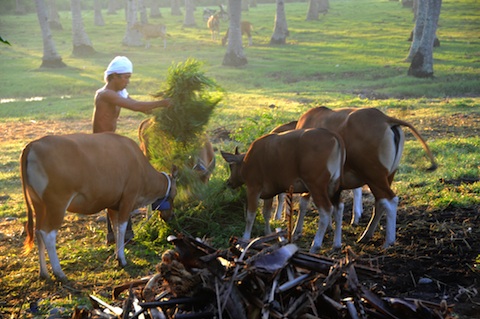
Even the cattle looked as though they had been painted so each was a duplicate of all others.

Feeding_the_Banteng_medium

By Bart Speelman from Pemuteran, Bali, Indonesia – Medewi Morning Bali, CC BY 2.0, https://commons.wikimedia.org/w/index.php?curid=11595580

When I think of paradise, the image formed in my mind is of a simple cottage with windows overlooking the sea, a palm tree just outside the window, and perhaps a cloud or two in the sky. That would be my Xanadu.

W is for Weehawken

It was the summer that changed my life–1968. I spent it in New Jersey where I shared a house in Union City with seven other young women, all college students, while we volunteered in an interdenominational arts/crafts/recreation program for elementary school-aged children. The church where I volunteered was in Weehawken, just a few blocks away from the house where we stayed.

Pastor Hank Dierck showed us the place in Weehawken that provided the best views of Manhattan, probably right where the photographer stood when the above photo was taken. It was also where Aaron Burr, the sitting Vice President, shot Alexander Hamilton, former Secretary of the Treasury, in a duel in 1804. Both men had been involved in duels in the past, but by then dueling was illegal in both New York and New Jersey. Hamilton died the next day in Manhattan. Burr was charged with murder in both New Jersey and New York. Burr was either acquitted or the charges were dropped. The rivalry between the two men arose from disputes in a number of elections going back to 1791. Let us be thankful dueling is no longer legal in any of the United States.

About 50 college students, most of us from the midwest, took part in the summer program. The organizers provided us with a week of orientation to the area which included suggested recreation and arts activities for the children. Most of the 50 volunteers were assigned to work in Jersey City churches where the majority of the children were African American. But those of us in Union City and Weehawken had a completely different mix of children. Most of ours were the children of Cuban immigrants.

I was shocked by the amount of litter I saw on the streets in Weehawken, even in the residential areas. So I devised an arts project I hoped would help the children realize they shouldn’t litter. First I made two copies of a list of things I knew they could find on the street that I felt should be tossed into waste baskets or garbage cans. I broke my class of 8- and 9-year-olds into two groups. We went outside, and I gave each group one copy of the list and a large paper bag. I sent one group east from the church and the other south so they wouldn’t be searching for the items in the same places. Once they had found and picked up each of the items on the list and bought them back in the paper bag, we went back inside to talk about how easy it was to find everything.

One boy told me it wasn’t easy. “I had to go all the way to the corner to get the gum wrapper,” he said.

I then asked them to draw a picture of their homes. When they were done, I told them they should glue at least one of the items from the bag to their pictures, in front of their houses. One boy must have figured out what I wanted. He said he didn’t want to mess up his picture, so he drew a waste basket to one side of the picture and glued his piece of litter into it.

Seven weeks after arriving in New Jersey, I flew back to Minnesota with tears in my eyes. Those seven weeks had changed me. When I left Minnesota, I had been looking forward to entering my junior year at Concordia College where I was majoring in German and minoring in Russian. I knew I wanted to travel, even live, overseas, and I thought being able to speak foreign languages would make that possible. But in the summer of 1968 I met a group of people, the parents of the children in my class, who needed to learn English as their second language. And I realized I didn’t need to study another language–I already knew one that was foreign to others: English.

Once back in college, I changed my major to English. I stuck with my Russian minor because I didn’t have time to change that, too. My German courses filled the number of credits I could devote to electives. And I set out to take every English course that wasn’t dedicated to literature. Because I wanted to teach the language–how to understand it, how to speak it, how to read it, and how to write it.

It took me a few years to complete my goal of learning how to teach English as a second or foreign language. Seven years later, in 1975, I was ready for that foreign living experience. I set out then for Iran, the first of 10 foreign countries I would live and work in before I retired.

V is for Virginia

One of the original 13 colonies, Virginia became my home state when I joined the US Department of State in 1985.

For the first six months of my career as a Foreign Service Officer, I lived in a studio apartment at the top of a hill overlooking the Iwo Jima memorial in Rosslyn, an area of Arlington, Virginia. Arlington is a city, but it is not part of a county, a geopolitical oddity referred to as an independent city. Virginia has 38 such independent cities. There are only three more anywhere else in the United States: Baltimore, Maryland; St. Louis, Missouri; and Carson City, Nevada.

During those six months, I completed State’s orientation course, referred to as A-100 because that was the number of the room where the first such course was taught. I also completed the Foreign Service Institute’s ConGen Rosslyn, a simulation of the work I was expected to do when I arrived in Stuttgart, Germany, and took up my position as vice consul at the Consulate General; and 14 weeks of German to brush up my college German and bring it to the level considered adequate to conduct visa interviews.

But a conversation a year later in Stuttgart made me realize I hadn’t yet accepted Virginia as my home. I met an American woman in the US Army in Stuttgart who told me I looked familiar to her. After we listed all the places we had each lived, without discovering any in common, the daughter of the Consul General mentioned that she thought I had lived in Virginia for awhile. I admitted I had been there for six months in 1985 while I was a student at FSI. The American woman’s eyes lit up at that. She had worked as a security guard at FSI in 1985. I looked familiar to her because I walked past her each day when I entered the building. Two insights hit me then. First, being somewhere for six months is living there. Second, I needed to pay attention to people I walk past each day.

I spent another six months in Rosslyn in 1987, after I completed my first assignment in Stuttgart. During those months, I completed more training at the Foreign Service Institute–area studies, budget and fiscal, personnel, and general services training. All that training was to prepare me for filing the administrative officer position at the US Embassy in Doha, Qatar. I would be the only American responsible for all those roles in Qatar.

Seven years later, in 1994, I finally accepted I was a true Virginia resident when we bought a townhouse in Arlington. I loved living there.

But then again, I loved living everywhere I have lived. There is no better way to live.