E is for Eritrea

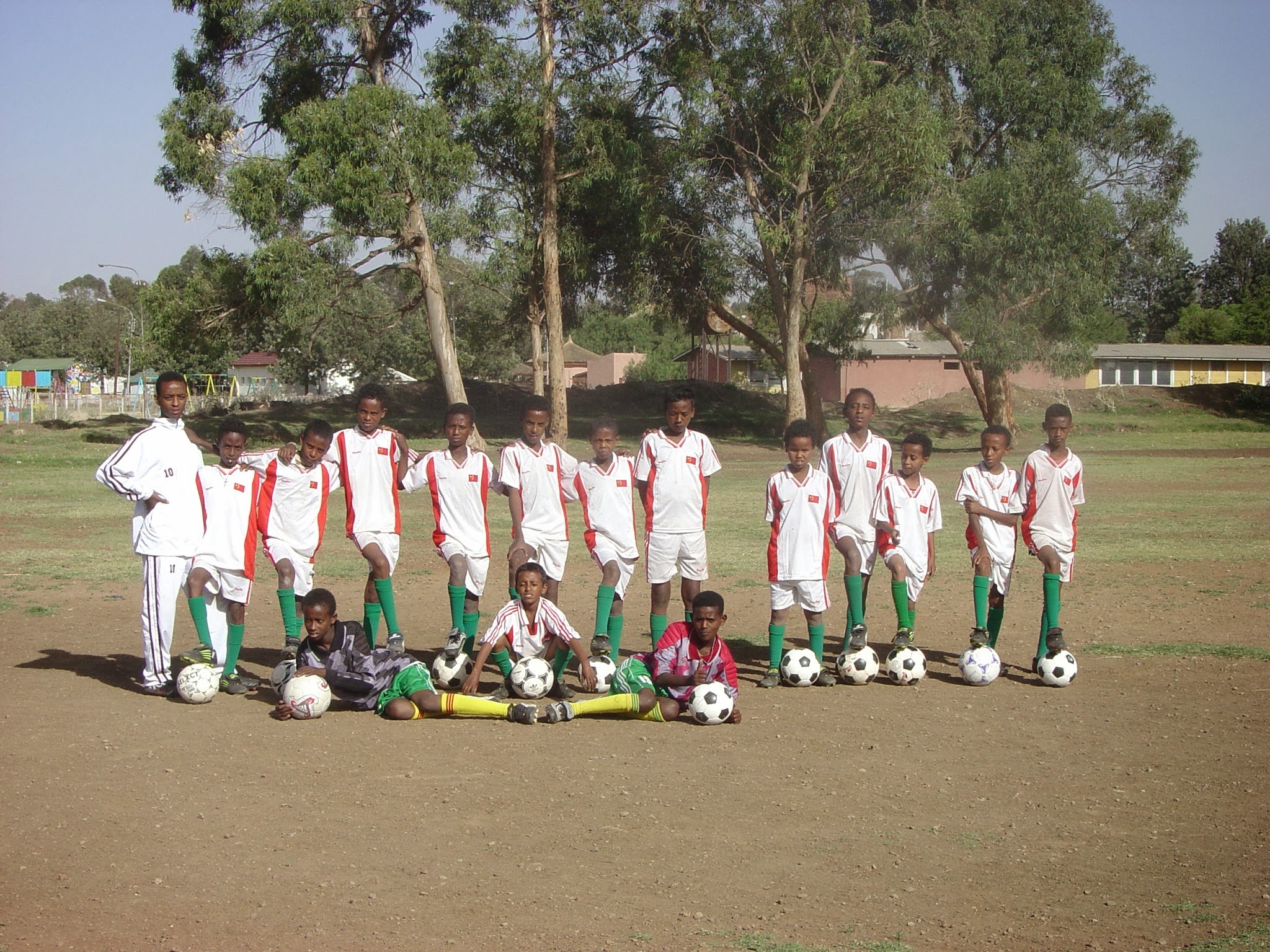
Team USA in Asmara Eritrea
Habtom (at left), Dawit (third from the right) and the other boys of Eritrea

Eritrea had been independent for less time than I had worked for the US Department of State when I arrived there in February 2004. I knew very little about it, only that it gained independence from Ethiopia in the early 1990s.

My stay in Eritrea was short–just four months. But by the time I left, a piece of my heart was firmly embedded in the country.

It all started one Sunday afternoon when I went with my friend from the embassy, Jewel, to a barbecue at the Israeli ambassador’s house. When we arrived, Jewel noticed that one of the tires on her car was flat. Always practical, Jewel decided there was no need for us to delay our arrival at the barbecue to replace the tire; we could find someone to help us change it when it was time to go home.

She was right. And it was her timing that made all the difference to the rest of my stay in Eritirea.

While Jewel pointed out to the volunteers where her spare tire and jack were, I stood back on the sidewalk, just watching. That’s where I was when a group of young boys approached. There were eight of them. They were carrying a t-shirt, each of four boys holding onto a corner of it as if it were ready to catch something. One of the boys approached and asked me for help. Since none of the boys appeared to be injured, I asked what kind of help they needed. He pointed to the shirt and said they needed money to buy uniforms.

At this point, I thought about my options. A) I could just shoo them away, telling them I couldn’t help, B) I could give them some money towards their uniforms, or C) I could spend the time I was going to have to wait for the tire to be changed talking with them.

I choose C.

The smallest of the boys, Dawit, was the only one who seemed comfortable speaking English. He translated as we talked.

First, I asked what kind of uniforms they needed. They explained that they wanted uniforms for their soccer team. I asked the boys their names. I only caught a couple of them. Isaias, Daniel, Habtom.

I asked how much money they needed for uniforms. They said each uniform cost 100 nakfa (Eritrean currency, the equivalent to $7.00). I asked how I could be sure they would use money I gave them for uniforms. After they couldn’t answer that question, I asked if I was going to have to trust them. Dawit nodded vigorously at that. Yes, I would just have to trust them.

When I noticed that the tire was nearly changed, I gave the boys 300 nakfa so they could buy three uniforms. And they went off down the street. But a minute later, Dawit and Habtom came back. Where did I live, Dawit asked. I told him I lived in the United States. But he wanted to know where I lived in Eritrea. I didn’t know my address. Someone from the embassy picked me up each morning and someone else dropped me off at home after work. When I explained that I didn’t know my address, they reluctantly went away.

But a minute later, Dawit and Habtom were back. This time, Habtom handed me a pen and asked me to write my telephone number on his hand. That I could do. And they rushed away again.

I never expected to hear from or see them again. But the following Saturday, Habtom called. Since he didn’t speak English, I was about to hang up when I heard him say,  “Habtom 300 nakfa.”

The next voice I heard was an Eritrean who spoke English and who told me the boys wanted to meet me the next day to show me their uniforms.

Every Sunday for the rest of my stay in Eritrea, I met with the boys of the soccer team, as many as 16 of them at one point. I watched them practice, took photos and videos as they played, and after practice they walked with me to my house where I gave them refreshments and we watched videos together–Finding Nemo and Bend It Like Beckham were their favorites.

That first day, only four boys had uniforms. So I bought the rest of the boys uniforms, too. And boots, and soccer balls, and better boots when the first set fell apart after a couple of games, and a second set of uniforms. I couldn’t think of a better way to spend my money or my time in Eritrea. I still can’t.
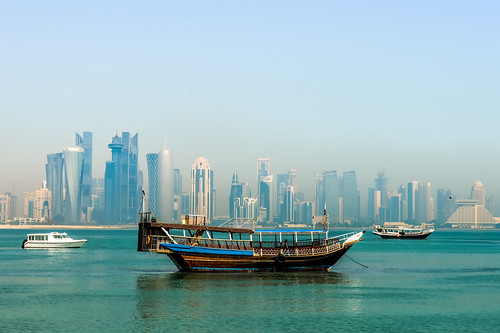

D is for Doha

When I got off the plane late one October evening in 1987 in Doha, my first thought was Who left the oven door open? The heat assaulted me at the top of the stairs set up on the tarmac to facilitate passengers getting off the plane. I had never felt such heat.

Doha seemed like a sleepy little town when I lived there from 1987 to 1989. I could barely find any information about it before I left. So instead, I read all about Saudi Arabia, including a cultural guide put together by members of the US embassy staff in Riyadh to help those assigned to the Kingdom prepare for life in an almost entirely gender-segregated society. Armed with that mis-information, I brought videos of every movie I ever wanted to watch, every book I ever thought I’d read, and every board game I could get my hands on. I expected to spend most of my two-year assignment there indoors, more specifically, in my own home.

But Doha was a surprise in so many ways. Those videos, books, and games I brought? Most of them stayed in the boxes. Of all the overseas assignments I had, none offered more to do than Doha.

My first weekend in Doha coincided with the first visit by a cabinet-level official, the Secretary of Energy, to the country of Qatar. I spent the two days before the visit traveling around the city to see all the places the Secretary would be during his very short stay. The evenings were spent in the homes of other staff members at the embassy, entertaining the White House advance team members so they didn’t have to stay cooped up in their hotel rooms.

That week turned out not to be exceptional. Every evening there were dinners, receptions, or other events I was invited to attend. Many evenings, there were both dinners and receptions or receptions and cultural performances. If I managed to spend an evening at home, it was usually in the company of 20-30 other people, support staff sent on temporary duty from Washington or expatriates from the US or Europe whose employers were important contacts for the embassy.

Doha will always have a special place in my heart. I met my husband there, one of the British expats in Qatar. The country of Qatar relied on expats from all over the world–still does. When I lived there, the population of the country was around 300,000, only one third of which were native Qataris. Two thirds came from somewhere else–India, Pakistan, the Philippines, other Arabic-speaking countries, Europe, and North America.

Doha has a special place in the hearts of most European and American expats who lived there. Evermore after, when I run into someone I learn once lived in Doha, I see wistfulness in the eyes as we begin to share stories of how much we enjoyed living in that tiny little city in a very small country. As a small town Midwestern girl, I felt entirely at home in Doha, once I got used to the heat.

C is for Cairo

I didn’t want to go to Cairo. I had just arrived in Abu Dhabi, United Arab Emirates, in August of 1996 to take up my responsibilities as management officer of the US Embassy there. I was eager to get started. But instead, I was sent for a three-day conference in Cairo less than a week after arriving. The conference was important. But the financial management officer was also going, and I didn’t see why we both needed to go. But the boss insisted. So I went.

On the first day of the conference, our seats were assigned. Table tents with our names and the name of the diplomatic post we represented were already on the tables. Mine was in the front row. Abu Dhabi had the alphabetical advantage I rarely enjoyed personally.

After getting settled, I turned around and noticed that the name on the table tent just behind me was familiar, Ohaila Ataya. Almost ten years before, Ohaila worked for me at the US Embassy in Doha, Qatar. I hadn’t seen her since.

I was so pleased to see her name, and then to see her come forward to take her place, I nearly cried. We hugged and chattered back and forth about how happy we were to see one another after so long.

I had hired Ohaila as the financial management specialist in Doha and I believed that she had learned much from me. But I had learned so very much more from her.

Ohaila is Palestinian. She and her sister had lived in Doha most of their lives since her family lost their home in what had been the British Mandate of Palestine. Less than a year before, their parents left Qatar as immigrants to the US. Ohaila and her sister had to stay behind, living with their aunts, working at the US Embassy.

From Ohaila, I learned much about the Palestinians who were displaced when the state of Israel was formed. Most of them left their ancestral homes. Many ended up in refugee camps in Jordan. Others with more means took jobs in Saudi Arabia, Kuwait, Qatar, Bahrain, or Oman. Some emigrated to the United States.

The generation of Ohaila’s parents sent their male children to the US, Canada, or Europe to university, hoping they would make a better life for themselves and their families elsewhere–once they stopped dreaming that Palestine would be returned to them. That generation kept their female children close, planning marriages to the young Palestinian men sent off to other lands so that they, too, could escape. But many of the Palestinian men fell in love with and married the women in the countries of their studies. So the Palestinian women left behind became spinsters, denied children of their own because of the lack of eligible men to marry and the lack of freedom to choose a non-traditional life.

And yet Ohaila always smiled. She was a devout Muslim woman who adhered to the pillars of Islam while at the same time respecting the faith of others around her. She explained aspects of Islam that Westerners find so difficult to understand. For example, I had always heard reference to how simple it was for a man to divorce his wife by saying “I divorce you” three times. But Ohaila pointed out that the requirement to say it three times was to provide assurances to women that a man was certain about what he said, not shouting it in anger. In context, Ohaila’s explanation made sense.

Ohaila never blamed others for her situation. She viewed everything in her life’s path as an opportunity. She demonstrated her faith every day. Her example gave me reason to want to understand more.

And Cairo gave me an opportunity to connect with her again. So while I didn’t want to go, I’m glad I did. I even saw the pyramids and rode on a camel.

B is for Barbados

Ever dreamed of living on a tropical paradise island? I did. Both the dreaming and the living.

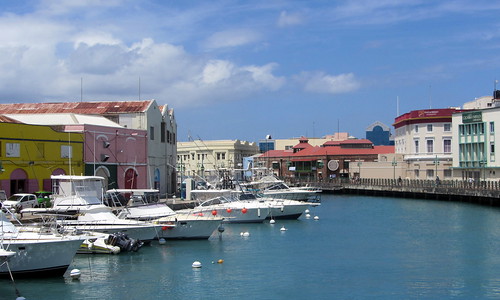
From December 1989 to June 1991, I lived in Bridgetown, Barbados, where I worked first as one of six consular officers and then as the financial management officer of the US Embassy.

But Barbados wasn’t exactly what I expected. Sure, they speak English there. But a common language doesn’t ensure good communication. Even more important, the fact that English was the common language meant there was a good deal of assuming going on that we all should understand one another, so if we didn’t, it must be somebody’s fault.

It took a physical fight between a local employee, Kay, and the wife of one of the Americans to learn why we miscommunicated so often. Let’s look at three factors–Barbados’ British history, their language, and being in paradise.

Factor #1: It’s a former British colony, so they are just like us, right?

Wrong. Let me count the ways.

First, they drive on the left side of the road. And they stop to have a conversation in the middle of the road if they encounter someone they know coming in a car from the opposite direction. That stops traffic in both directions. Seemed impolite to outsiders, but not stopping would have been impolite to Bajans (the term people from Barbados use when referring to themselves).

Second, imagine this scenario: You see a woman walking down the street with a young boy whose shoe laces are loose. Do you a) ignore them, b) get the woman’s attention and point out that the child’s laces are loose, or c) get the woman’s attention and tell her to tie the boy’s shoes. The Bajan answer? C.

In Barbados, one gets directly to the point with people one doesn’t know, but one beats around the bush with those one knows well.  (I was supposed to understand my slip was showing when someone told me it was “snowing down south.”) So we were always behaving too familiarly with people when we first met them by speaking indirectly and then shutting them down once we got to know them by speaking with them directly. What was polite to us was rude to Bajans and vice versa.

Third, there’s the difference between respecting privacy versus being polite. When the consular section moved into a new building where all office spaces were cubicles, we Americans observed the privacy that the cubicle walls implied by walking past the private spaces contained within them. The Bajans on the other hand invaded our privacy by barging into our cubicles to say Good morning–even if we were holding a meeting or were on the phone at the time. Once again, polite behavior in one culture was rude in the other.

Factor #2: They speak English there. But I rarely understood them.

When answering the phone in the afternoon, Bajans say, “Hello. Good night.” I felt the caller was about to hang up on me, not engage in conversation.

My first day on the job, my new boss asked me to read a telegram reporting on the arrest of an American, written by one of the local employees. My boss could hardly hide her amusement as I read the American was arrested for uttering. Uttering what? An obscenity, a threat, a promise? Uttering, it seems, is the verb for passing counterfeit currency.

In addition to using a transitive verb as an intransitive verb, Bajans use nouns as verbs, as in, “Where did you get that bike? Did you thief (pronounced tief) it?” Or “What did you do last weekend?  Just lime around?”

And then there are the words that mean something slightly different, like wife. I answered the phone for a single colleague one day. The woman on the other end told me to leave a message that his wife had called. Wife just means a woman with a relationship to a man. Then there is the word deputy or the phrase outside woman both of which mean a woman in a relationship to a man who already has a wife.

Factor #3: The paradise factor.

Everyone thinks living on a tropical island is paradise. But working on a tropical island changes the viewpoint. Just think: 12 hours of daylight, 12 hours of night, every day of the year. Those daylight hours correspond roughly to the hours spent getting ready for work, going to work, being at work, and going home from work. The rest of the time, it’s dark out.

In addition, Bajans seemed to group people into one of two groups–people they know and tourists. Bajans are very friends with both groups. But there are those they don’t know who aren’t tourists, like we were. Anyone in that category gets ignored. A greeter in a grocery store walked up to me with a big smile and asked me how long I had been in Barbados. When I told her I lived there, she turned and walked away. She probably thought that was the polite thing to do–not to bother someone who didn’t need her help.

So there I was, with my husband and son, living on a tropical island, where everyone spoke a familiar language that led me to misunderstand about half of what I heard, and where the social conventions made me insult the people I considered my friends by treating them, they thought, as though I didn’t know them at all.

And I loved every minute of it–well, once I finally caught on to what was happening.

That fight between Kay and the American woman? It happened when the American woman put her cigarette out in an ashtray she then placed on Kay’s desk as she reached for Kay’s phone to place a phone call–all without asking Kay’s permission. The American woman was from New York, a place where people have a reputation for being direct with strangers.

It as ironic that the incident led to conversations within the embassy about our different cultural perspectives. I wouldn’t claim the air was cleared throughout, but the conversations did lead to some of us gaining understanding that then led to enjoying the differences instead of being baffled by them, something I believe I would never have come to understand without the prompt of the fight.

A is for Antananarivo

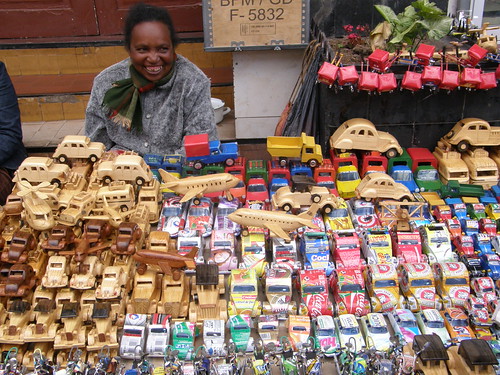
Cochecitos by copepodo, on Flickr

Check out the toy cars made from soft drink cans.

From September 2003 until January 2004, I lived in Antananarivo, the capital of Madagascar. Known as Tananariv during a period of French colonization, it got shortened even further to Tana, especially by foreigners who have trouble getting the multiple-syllable names out with accents in the right places.

I had always considered Madagascar, the fourth largest island in the world, to be part of Africa, but the Malagasy people don’t agree. On a map, the gap between Madagascar and Mozambique on the east coast of Africa gives the impression that Madagascar split off from Africa. But there is more evidence, hidden from view, that Africa first split off from Gondwana, the supercontinent, at which time Madagascar’s west coast was formed. We’re talking millions of years ago, nearly 200 million years ago. Then a mere 88 million years ago, Madagascar split off from what since became the Indian sub-continent. It then drifted west. The minerals and precious gems found underground are similar to what can be found in India.

Its people also do not seem African. And they aren’t. The original people who settled Madagascar came from islands in the South Pacific. The people look more like Indonesians than Africans. They are short in stature and lighter in skin tone. They dress more like the people of Indonesia. The women wear sarongs and shawls around their shoulders. And their original animist religious traditions are more like those of Indonesia. They revere their ancestors and periodically remove the bones from their tombs in a ceremony referred to as turning the bones. Once the bones are removed, the family gathers to celebrate after which the bones are rewrapped in silk, sprayed with perfumes, and then returned to the tombs.

Madagascar is also home to unique plants and animals, the most famous of which is the lemur. More than 100 species of lemurs exist, all of them endemic to Madagascar. They range from the size of a mouse to a rhesus monkey. The largest, the indri, has a very distinct call which some people compare to a baby crying. Listen and decide for yourself.

By the way, the movie Madagascar got it right: the natural enemy of the lemur is the cat-like fossa.

For more information about Madagascar and Antananarivo, check out the following:

Enjoy some music from Tarika, a Malagasy group focusing on traditional Malagasy music and its roots in Indonesia:

A to Z Challenge Theme

OK, I know I’m ten days late. Revealing my #AtoZChallenge was supposed to take place on March 21. But hey, I didn’t learn about the A to Z Challenge until March 28. So I’m catching up.

My A to Z Challenge Theme will be places I have lived or stayed long enough to make it to my list of favorite places in the world. Revisiting places in alphabetical, rather than chronological, order may even help me uncover some subconscious insights. I hope you’ll come along with me to see.

For more information about the challenge, check out the A to Z Blogging Challenge blog.

A to Z Challenge

I just signed up to take part in the 2016 A to Z Blogging Challenge. Wish I had heard about it sooner because some planning would probably improve my posts. But the lure of discovering other writers and their thoughts was greater than my fear of looking silly.

So each day in April (excluding Sundays), look for my alphabetically organized posts on reading and writing and anything else that strikes my fancy that isn’t one of those.

Book Review: The Orchid House

Three starstheorchidhouseLucinda Riley’s New York Times 2012 best seller, The Orchid House, spans seven decades and two continents, and addresses the lives of three generations of landowners and their employees and their descendants in Norfolk, England. The three generations of the Crawford family, owners of Wharton Park, are on the verge of losing the estate throughout the novel, but saving Wharton Park remains at the center of all the twisted tales and secrets revealed when Julia Forrester, the granddaughter of a gardener at the estate discovers a diary at a sale by Harry Crawford, the grandson of the owner when her grandfather worked there. The two discover the diary in the old hot house and assume that it must be Julia’s grandfather’s. Rather than opening the diary to read it herself, Julia brings it to her grandmother, Elsie, assuming she would like to keep it. But Elsie knows the diary wasn’t her husband’s. And she knew it was time to share a secret that involves both the Crawford and Forrester families.

While the story is beautifully told, I felt the author tricked the reader rather than simply revealing details about the secret in layers so the reader could willingly suspend disbelief. The central premise, that a half-Thai, half-British child, described as the spitting image of her Thai mother, would be accepted as the natural child of a British couple, spoiled the story for me. The happily-ever-after ending also resolved both the personal and financial tension of the tale too neatly, too quickly. I was surprised to find the book was categorized as historical or literary fiction rather than romance. The full story line more closely matches a classical romance than literary fiction.

Genre: Historical Fiction, Literary Fiction, British and Irish Fiction
Length: 468 pages
Publisher: Atria Books (February 14, 2012)
Publication Date: February 14, 2012

Book Review: Farewell to Manzanar

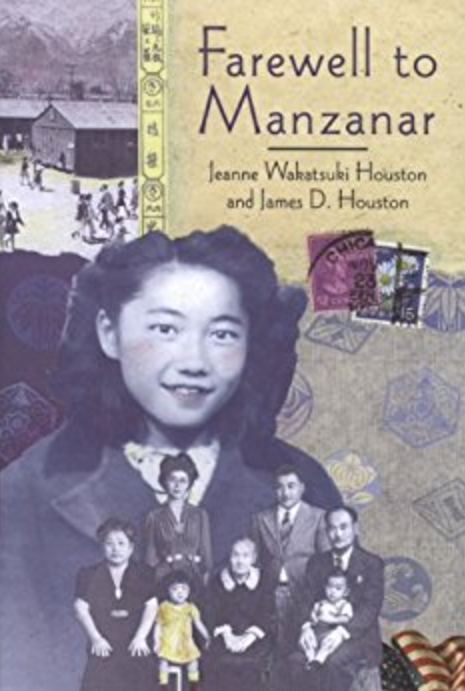
Four starsfarewelltomanzanarJeanne Wakatsuki Houston revisits the three years she and her family spent in Manzanar, one of ten internment camps run by the US War Department for relocated persons of Japanese ancestry during World War II. Her father had been taken away earlier, arrested for presumably supplying fuel to Japanese submarines from his fishing boat off the coast of Southern California two weeks after the bombing of ships at Pearl Harbor. She survives. Her parents and older siblings, less so. The Japanese-American way of life did not. Houston supposes the traditions would have died anyway, but internment accelerated it.

Houston tells of how camp life for a child was part adventure, unlike the burden it posed to the adults. She also tells of how camp life began the disintegration of Japanese family life as extended families were separated from one another, and even when they could remain together, there was insufficient space for family events, such as eating a meal together, to happen. Yet in spite of this, families did what they could to make the overcrowded and insufficiently insulated homes as much like homes as possible. Setting rocks among raked sand in gardens outside the entrance to bring a bit of beauty, a bit of familiarity in the midst of a hostile environment.

Houston told her story in 1973, more than forty years ago. But the lessons of the story are important today as well. Fear of those who look different, whose traditions are different, whose language is different, can lead to intolerable policy decisions, as was the case during World War II. We must learn from the mistakes of the past so that we do not repeat them.