Sell Your Books To Non-Bookstores?

Getting your books into non-bookstores–an unconventional sales and marketing scheme. Keep thinking outside the box when marketing your books.

Kristina Stanley's avatarKristina Stanley

Dollar Store D$AFollowing my own advice, I’ve restocked two stores in the small town near me with DESCENT and BLAZE.

This happened in two ways.

As per the advice I give in the guide, I went by one of the stores and noticed they were down to 2 copies of Descent and none of Blaze. I called and asked if I could bring more. The store bought 6 or each and agreed to buy 10 of AVALANCHE as soon as I receive the print editions.

The other store send me a message asking for more books. I didn’t even have to go there to check on the stock.

We are heading into summer, hence tourist season and that’s when the books tend to sell well in our town. The timing couldn’t have been better.BLAZE and DESCENT LAmbert

My books are now selling in Lambert’s Pharmacy, The Dollar and General Store, and Sobeys. They get…

View original post 96 more words

Readers Write-Swimming

The Sun banner

Each month, The Sun magazine offers fiction, poetry, essays, interviews, and photos in a black-and-white format without advertising. Each issue includes provocative ideas from people of science, religion, philosophy, the arts, or a combination. Each issue also includes Readers Write, a feature compiling nonfiction submissions from the magazine’s readers on an intentionally broad topic. Occasionally I submit pieces for consideration. More often, I write essays on the topics too late to submit them.

This piece should have been submitted by December 1, 2015, for consideration for the June 2016 issue.

My home town didn’t have a swimming pool, but the larger town across the river did. And each summer, for six weeks in the mornings, they offered swimming lessons.

The swimming pool was a mile and a half from my house. The summer after I completed first grade, I set out at 9 a.m. each weekday morning with three kids from the house across the street to walk to the pool for our 10 a.m. lessons. Charley, the oldest, was responsible for getting the rest of us–me, his sister Margaret, my age, and his brother Bobby, a year younger than Margaret–to lessons on time. We carried our bathing suits rolled up in a single bath towel stuffed into an empty plastic bread bag with a sandwich for lunch, Charley leading the way and the three of us younger kids following behind.

Margaret, Bobby, and I were in the Red Cross Beginners level class. Charley, three years older, was in either the Intermediate or Swimmers level. He didn’t spend any time with us once we arrived at the pool. The others in his class didn’t have younger children to watch out for. He wanted to spend time with his peers. He waited for us outside the changing room at the end of the lessons, staying as far away from us as he could get away with before we headed homeward.

I was afraid to put my face in the water. Until I could, I would never pass the Red Cross Beginners level swimming lessons. I could do everything else, including jumping into the pool from the edge, completely immersing myself in water for the length of time it took to bounce back up to the surface. But I panicked whenever I put my face into the water.

I practiced at home, filling the bathroom sink with water and then forcing myself to put my face into it. But instead of becoming comfortable, I held my breath for as long as I could until I pulled away from the sink, gasping for air.

I repeated the Beginners course each year for four more years, each year with younger and smaller children around me than the year before. By the time I completed fifth grade, I was embarrassed to be so much older than the others in my class. Especially since I already knew how to dog paddle and tread water; they didn’t require putting my face into water. I could even float on my back, completely relaxed with hands resting on my belly. But I couldn’t float on my stomach with my face in the water.

I don’t recall if I found a way to get over my fear long enough to keep my face in the water in order to pass or if the instructor just decided I needed to move on, even without overcoming my fear. I passed that year, finally advancing to the Intermediate class the following year.

By the time I reached the Intermediate level, my hometown had built a pool just half a mile from my house. I spent mornings, afternoons, and evenings at that pool every summer, even challenging myself one summer to swim laps at the five-foot stretch of the pool until I had swum a mile.  But I still didn’t put my face in the water.


Homework: Law of Balance

A prompt from 13 Steps to Awakening:

Homework

  • Find all the areas in your life that are out of balance where you paid less than what you received (and not just in terms of money). Now find the duality that they are a part of to figure out what you need to do to balance the other side of the equation. Discuss how you are going to follow the Law of Balance once you finish the course and how you will know if it is working in your life.

This is a difficult, though intriguing, assignment. I understand what Alex means by the law of balance, or at least I think I do. But I have consciously tried to avoid putting things in my life on a scale to measure them. To do so feels as though I assume others are out to cheat me or that I am out to get more than I deserve. Ignoring the balance makes it possible for me to live as though I do not care.

In fact, lessons from my childhood emphasized the importance of doing more for others than others do for me. This is most easily accomplished by not taking credit for what I do or hiding my part in something from those who benefit. But after reading the lesson connected with the law of balance, I can see that even this in fact ensures my life is out of balance, even if my objective is not self-centered.

In my spiritual life, I know that I have already received the gift of grace, a gift I do not deserve. And in response, I offer the gifts I can give–my time, my talents, and my treasures–through my church as well as through charities and civil society organizations for the betterment of society in general. I do not expect anything in return, though I almost always discover my gifts return to me in unexpected ways through the friendships formed with others in my church or other organizations. I believe these actions and observations keep my life in balance.

In my personal life, I expect the best from those around me, in large part because I know I will likely never receive more than I expect. But if others react to me with less enthusiasm, less good will, or less generosity, I try not to behave as though I am a mirror, reflecting back what I received. I prefer to react as though I am a lamp, shining light on what is hidden from view. Time after time I learn that when I feel annoyed, there is usually something I misunderstood or never knew at all that, once revealed, takes away my reason for being annoyed. So long as I can keep that in mind, I can keep my mind and heart open to my surroundings and everyone in it.

The above prompt is part of the fourth of 13 free lessons, developed by Alex Moses, Life Strategist, available on the A Life Answers website, shared with his permission.

Readers Write-First Love

The Sun banner

Each month, The Sun magazine offers fiction, poetry, essays, interviews, and photos in a black-and-white format without advertising. Each issue includes provocative ideas from people of science, religion, philosophy, the arts, or a combination. Each issue also includes Readers Write, a feature compiling nonfiction submissions from the magazine’s readers on an intentionally broad topic. Occasionally I submit pieces for consideration. More often, I write essays on the topics too late to submit them.

I submitted this piece for consideration for the March 2015 issue, though it wasn’t selected.

My first love was far from traditional. My love wasn’t a person–a boy or a girl with the power to cause my heart to leap for joy–or a pet with the power to love me back. My first love was a place, a place I discovered at the bottom of a wooden trunk in the basement of my parents’ first house, a place so unlike what surrounded me every day in my Midwestern hometown, where everyone was either Scandinavian or Catholic.

The vision of my special place rose from the trunk attached to a purple silk kimono my father brought back from Japan at the end of World War II. Dad hadn’t been a soldier; he joined the Merchant Marines, encouraged by his uncle Bill’s stories of the adventures he would have. At the time, service with the Merchant Marines wasn’t considered military experience, but it brought Dad into the war nonetheless as the ships on which he sailed brought supplies and provisions to the military ships in the Pacific theater. His service extended beyond the end of the war, giving him the opportunity to step on the shores of one of our country’s then greatest enemies–Japan. And he brought back trinkets including the purple kimono that captured my preschooler’s attention so completely. I wanted to know everything about this place that I only knew was far away and very different.

It was 25 years later that I finally met my first love. After having lived and worked for two years in another very foreign place–Iran–I traveled home by heading east so I could stop for a few days in Japan. Four days were all I had, and by the end of them my jaws ached from continuously smiling from ear to ear. My love was everything I had hoped for.

But it took another 15 years to realize what a gift my parents had given me by allowing me to fall in love with this place. Then I was living on the east coast where I worked for the U.S. Department of State. My parents came for a visit and while we walked on the mall between the Lincoln Memorial and the Capitol building, a Japanese tourist stopped my father to ask for directions. When Dad rejoined us after having pointed the way, he remarked that he wouldn’t have believed it if someone had told him 40 years earlier that he would some day have a conversation with someone from Japan in the capital of our country. And it hit me then that while I was falling in love with Japan, my parents and their friends hadn’t yet gotten over the losses they held my first love responsible for.

Eight-Week Challenge: Week Three Results

Week three. I knew things would change. Time for my report.

As a reminder, here are my goals for the eight-week challenge:

  • eat more nutritious food with fewer empty calories,
  • spend one day a week reading the backlog of magazines sitting on the end table (changed to read an average of five magazines each week from the backlog), and
  • write at least 500 words per day for at least five days each week.

week3

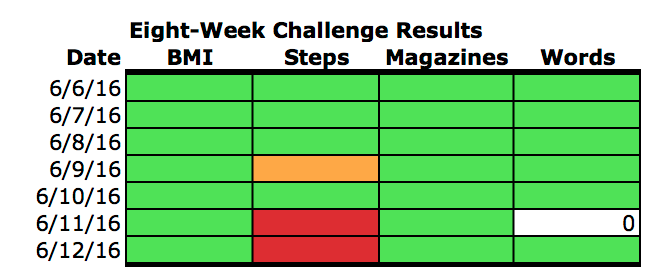
This was the week I knew would come–I stumbled. This week I stumbled on two: I didn’t get in as much walking as I had hoped, falling short three days this week; and I missed my writing goal three out of the seven days, one day short of my goal of at least five days each week.

But I still learned something.

First, I discovered that instead of having more energy on my plant-based diet, I found myself sleepy in the middle of the day several times this week. So I took naps. And that meant less time for writing and exercise. A friend, one with a solid background in nutrition, suggested it may be my diet is short on protein. She pointed out that it is necessary to eat a lot of beans to get the same level of protein I was getting before through eating meat most days. So I may cut short my goal of sticking entirely to fruits, vegetables, nuts, seeds, and legumes for six weeks and consider a four-week transition long enough. This should not negate my first goal; it will just temper how I manage it. It had always been my plan to add in other foods after six weeks.

Second, I concentrated more on the quality of my writing which diminished the quantity. A better goal, though harder to measure, is a balance between the two.

I know next week will be challenging. There are several events on my calendar that deserve more time.

Book Review: The Ivory Caribou

theivorycaribouFive Stars

Recently widowed Anne O’Malley undertakes genealogical research into her father-in-law’s past as a way to remain connected to her deceased husband, but she discovers instead an extended Inuit family eager for her to join them for a future that connects her with the past at the same time as it beckons her forward into a new life.

Caroline McCullagh has woven elements of mystery, romance, and cross-cultural adventure into this, the first in a series of novels with Anne O’Malley at their center. Anne is not a typical romance protagonist. She is sixty and was married for nearly forty years to Robby, her much older husband. Together, she and Robby prepared for Anne’s financial independence during what they anticipated would be Anne’s life on her own. In spite of the planning, two years after Robby’s death, Anne continued to cling to Robby’s memory instead of moving forward.

The book is well written and the story so compelling I couldn’t put it down. And it wasn’t just the story that kept me turning the pages. The cross-cultural details Anne learns when she encounters her extended Inuit family even gave me insights into my own Scandinavian background. For example, as I grew up in a Minnesota area largely populated by northern Europeans, my parents insisted that expressing emotion–whether positive or negative–was undesirable. I could describe that behavior to others, but I couldn’t explain it. In McCullagh’s novel, I learned this prohibition of expressing emotions is also a characteristic of the Inuit culture, a necessity because of the long periods of time all family members were confined to small spaces where even minor loss of control could spiral the family members to unacceptable actions. That explanation fits the circumstances of my Norwegian ancestors as well.

I know Anne’s story continues, and I can’t wait to read more.

  • Print Length: 283 pages
  • Publisher: iCrew Digital Productions (May 25, 2016)
  • Publication Date: May 25, 2016
  • Genre: Literature & Fiction, United States, Native American; Romance, Multicultural & Interracial

Book Review: The Emigrants

Four stars
theemigrantsEight adults, each for their own reasons, reach the point they feel abandoning their homes in Sweden in favor of enduring a treacherous sea voyage to New York is the only way to find a dignified life for themselves and their eight children. The sixteen featured emigrants joined more than sixty other courageous souls on a journey they knew almost nothing about for a new life in a land they had only heard of. They knew no one who had made the journey before. Many among them lost their faith, and some even their lives, before the small ship arrived in New York harbor.

Moberg’s The Emigrants brings the bleak conditions of mid-nineteenth century Scandinavia to life, uncovering the near starvation facing families whose ancestral homes had been divided into plots so small they no longer could support the same, or in many cases an even larger, number of people. While not mentioned in Moberg’s work, mortality rates in Sweden began declining in the latter half of the seventeenth century which contributed to the challenges. Intolerance of divergent forms of worship, societal shaming of non-conforming individuals, and unhappy marriages also contributed to the motivation of those earliest pioneers seeking a better life in North America. The first half of the novel painted a richly detailed landscape of the conditions, especially of the hunger the children faced and the pain those conditions brought to the adults who could not overcome the conditions that brought on the hunger.

The last half of the novel, describing the sea voyage and the disease and unhealthy conditions the travelers had to endure, was equally well detailed but felt a bit longer than I thought necessary, the reason I rated the book four stars, not five.

Having already read O.E. Rolvaag’s Norwegian trilogy beginning with Giants in the Earth, I was eager to compare The Emigrants to it. Moberg’s work is like a prequel to Rolvaag’s work, and since Sweden and Norway were ruled by the same monarch during the timespan of both author’s tales, I felt the circumstances that prompted both Norwegian and Swedish emigration were likely very similar. For anyone who wants to know more about the emigration/immigration of ancestors from Scandinavia, I would recommend this book wholeheartedly.

  • Print Length: 404 pages
  • Publisher: Minnesota Historical Society Press; Revised ed. edition (July 24, 2009)
  • Publication Date: July 24, 2009
  • Genre: Literature & Fiction, Literary Fiction, Contemporary Fiction

Eight-Week Challenge: Week Two Results

Week2

Week two–done! Time for my report.

As a reminder, here are my goals for the eight-week challenge:

  • eat more nutritious food with fewer empty calories,
  • spend one day a week reading the backlog of magazines sitting on the end table, and
  • write at least 500 words per day for at least five days each week.

What I learned during week two of my eight-week challenge:

  • Body Mass Index: So long as I continue eating a plant-based diet, I not only meet this goal, but I also feel good all day long.
  • If I don’t get up early enough to get in a good 30-minute walk before I do anything else, I’m not going to meet my daily goal of walking at least 10,000. Or even my half goal of walking 5,000 steps.
  • I changed the way of representing the status of my goal to get rid of my magazine backlog to report on whether I have read at least 5 magazines a week, the rate at which I need to read them to clear up the backlog. Green means I’m on track. But I know I will have to work very hard to keep it up.
  • Writing at least 500 words a day is easy–when I’m not on grandparent duty. But quantity doesn’t equal quality. I am going to have to work on that.

Readers Write-The Sofa

The Sun banner

Each month, The Sun magazine offers fiction, poetry, essays, interviews, and photos in a black-and-white format without advertising. Each issue includes provocative ideas from people of science, religion, philosophy, the arts, or a combination. Each issue also includes Readers Write, a feature compiling nonfiction submissions from the magazine’s readers on an intentionally broad topic. Occasionally I submit pieces for consideration. More often, I write essays on the topics too late to submit them.

This piece should have been submitted by September 1, 2015, for consideration for the March 2016 issue.

I managed to get through ten years as an independent adult without owning a single piece of furniture. I had always thought the first piece of furniture I would have to buy would be a bed. For many years I was pleased to have avoided that purchase. In my mind, not owning furniture was synonymous with being independent, being able to make my own way through the world, taking advantage of what serendipity offered. But the furniture purchase that affected me most was when I bought my first sofa.

My first apartment–while I was still a college student in my Minnesota hometown–was furnished. My hometown was a college town. The influx of students who attended one of the three colleges in the area demanded temporary quarters only nine months of the year. Most apartments were therefore furnished.

After graduation, I moved from Minnesota to Berkeley, California, where my first apartment again was furnished. Five months later, I moved in with an older woman who had recently lost her husband. She was confined to a wheelchair and didn’t like the idea of living alone. I slept in her fully furnished spare bedroom. That arrangement didn’t work out for long. By the time I knew I had to move again, I had arranged to borrow furniture from the church I worked at when I found my first unfurnished apartment.

Three years later, I moved across the San Francisco Bay to attend graduate school at San Francisco State University. My first apartment in the city was a studio that had been servants’ quarters a few decades earlier. Furnished again. In the next three years, I had three different roommates and lived in four different apartments. Each time, a roommate had all the furniture we needed, including a spare bed for me.

During all this time, I was able to pack up everything I owned into my 1969 VW bug. It felt liberating to be that free–to be able to pick up and move if something attractive enough to entice me came along, or if something disastrous encouraged me to move on.

My next two moves were overseas, first to Iran and then to Romania, where my sponsoring organization provided a place to live and the furniture needed to fill it. Even when I returned to the United States, to Illinois, I was able to find a furnished apartment just down the street from my first full-time teaching position back home.

But in 1979, ten years after I graduated from college, I bought a sofa–a brand new, three-piece sectional, big enough for two people to sleep on if one of the two curled up all through the night.

It was a symbol of my having truly entered adulthood. I no longer needed to shop at thrift stores or accept hand-me-downs from friends. It should have been a reason to celebrate.

But it also represented the end of my peripatetic lifestyle. As the first piece of furniture I owned that I couldn’t disassemble and somehow cram into a vehicle, it felt more like a millstone around my neck than a certificate of passage into adulthood.