IWSG-July

Insecure Writers Support Group Badge
Once again, the first Wednesday of the Month has arrived, the date on which many of us bloggers write about our hopes and fears in the Insecure Writer’s Support Group, founded by Alex J. Cavanaugh. Please visit either site for more info and a list of participating bloggers, to join, or offer encouragement.

For the past five weeks, I’ve been doing a lot of catch-up reading; not novels or memoirs or anything else with a hard cover. I’ve been reading back issues of magazines that have been piling up on a cabinet next to the sofa. The result has been both inspiring and anxiety producing. The range of topics inspire, as does the excellent writing. But that also explains the anxiety. Following are some examples:

Most occupants of my complex, as far as I could tell, had a mental disability or illness. Meghan’s speech and mannerisms suggested that she was no exception. . .she didn’t seem to fit in with the group, standing off to the side, looking miserable and rolling her eyes at their immature wisecracks. . . .

Wearing her usual frayed blue sweat suit and graying sneakers, Meghan plowed past me, head down, swinging her free arm, dragging that leg, and ignoring me for all she was worth. Though we had encountered each other six or seven times in the hall, she had not greeted me once, as if she were angry about something I’d said or done.

Poe Ballantine, “Even Music and Gold,” The Sun, November 2014

I love this description of Meghan though not a word about her height, weight, hair color, body shape, face shape, or eye color appears. I can see her, though I know I have supplied all those usual descriptions missing from Ballantine’s description. These sentences inspire me to describe one or more of my characters using behavior and actions in place of the usual.

One evening Cole invited me to his house. I didn’t want to go, but I had no strong sense of self, nothing to steer by. I had no way to say no. . . .My deepest fear wasn’t death at the hands of Cole, although I did fear that. I was more afraid of being like him.

. . .I’d thought college would be like the library table in high school, but instead of skipping school, we’d stay at the table and turn into smart people. . . .I knew more trees than people.

. . .I felt I was making a mistake. But, then, I always felt I was making a mistake: walking into a classroom, going on a date, eating dinner with a friend. Everything I did felt wrong, wrong, wrong. . . .I simultaneously wanted to protect Cole and to pretend not to know him.

. . .But I hadn’t discovered a bold, brave part of myself. It was nothing like that. What I’d discovered was that I could pretend to be someone I was not, and that people could be fooled by this, and that this could save my life.

Heather Sellers, “I’ll Never Bother You Again,” The Sun, February 2015

Much of the above feels very familiar. But that would probably be true for nearly any woman who survived her teenage years. In addition to their familiarity, these passages are frank and brave for their self-revelation (a note on the article indicates names were changed to protect privacy, indicating the piece is not fiction). I hope I can become as brave in my memoir writing. I suspect what I have been hiding of myself in my work may make the difference between a series of sometimes humorous vignettes and a story worth sharing.
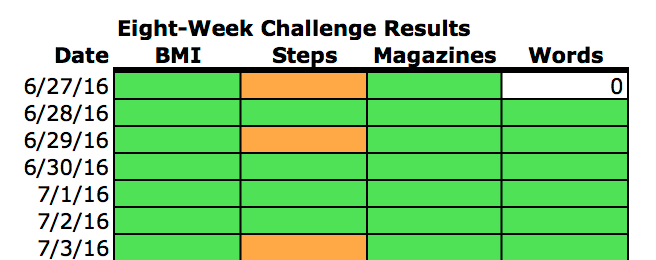
Eight-Week Challenge: Week Five Results

week 5

How Am I Doing?

Hooray! I have much progress to report on this week.

As a reminder, here are my goals for the eight-week challenge:

  • eat more nutritious food with fewer empty calories,
  • spend one day a week reading the backlog of magazines sitting on the end table (changed to read an average of five magazines each week from the backlog), and
  • write at least 500 words per day for at least five days each week.

Healthy Eating

Two important events passed this week in addition to my meeting my goals for body mass index and improving my record for walking. First, I met with both a nutritionist and an endocrinologist regarding my current eating pattern and its impact on my health. The nutritionist confirmed that I’m making all the right choices in what to eat, but she recommended some tweaks to ensure that each meal is balanced. Second, my A1C and fasting blood sugar levels as tested this week were back within the desired target range.

Now I know my endocrinologist and I don’t agree entirely on what should follow that meeting. She was pleased with the results of my blood tests, but her recommendation is that I continue taking two medications that I believe are no longer needed because of the changes I have made in both diet and exercise. She says once a person is diagnosed as diabetic, that person is forever and after diabetic. I favor the opinion that diabetes offers and on-off switch, that changes in diet and exercise can switch the condition back off again.

Because I prefer following my vision, I will return to see her again in three months, during which time I plan not to take the two medications to see how the numbers look then.

Clearing Up the Backlog

Though it doesn’t show on the chart for week five’s progress, I have killed off the magazine backlog. Today I read the last of the 34 magazines in that pile. A couple of new issues have arrived this week and I am determined not to allow a backlog to reappear. I’ve also decided to send a few issues off to friends I believe will appreciate them as much as I did.

Writing

Though I missed one day, I met my goal of writing at least 500 words at least five days in the week. And that means it is time to increase my goal for the rest of the challenge. My new goal will be to write at least 750 words for at least five days in the week.

Three weeks left. Once again, thanks to Danielle for setting out this challenge.

Happy Independence Day

When my husband’s Time magazine arrived with its headline, “240 Reasons to Celebrate Independence Day,” I was reminded of my most memorable Fourth of July, the one 40 years ago, our country’s bicentennial. But unlike most Americans around in 1976, no fireworks or sparklers featured in my bicentennial celebration.

On July 4, 1976, I was living in Tehran, Iran.

Earlier that week, Ed, the director of the English teaching program I worked for, received a phone call from the US embassy advising him that Americans in Iran should keep a low profile on Independence Day. The embassy suggested that we not gather in a public place or take part in any showy displays.

On the morning of July 4, a group of us headed out of town, in the direction of Karaj Dam. Very few of us had cars; so six or more crowded into the few we had, including one old enough to be classified an antique, the car I chose. Fortunately, Ed assured us that he wouldn’t leave us behind if anything happened to the car. As the director of the program, Ed had been assigned a car and driver, a shiny new car and an accomplished and very competent driver.

We couldn’t resist testing Ed. A few miles out of town, our driver, Dick, pulled over to the side of the road, and we waited. Within ten minutes, we saw Ed’s car coming back on the other side of the road. Dick pulled back onto the road, revving up to top speed (about 50 mph) as quickly as possible with a car full of laughing colleagues.

Ed’s driver caught up with and passed us, and we all waved and smiled, satisfied that we had proved Ed meant what he said, and that we could also have some fun along the hour-long drive.

Like the children in the story of the boy who cried wolf, we just had to try the same the same gag. Again, we saw Ed’s car return, and again, Dick accelerated onto the road, speeding ahead until Ed’s driver caught up with us and zoomed ahead.

Also like the story of the boy who cried wolf, something did go wrong. Dick’s car slowed, in spite of the pressure he kept on the accelerator. It continued to slow. Dick pulled the car over to the side of the road, got out, and popped the hood open. The rest of us in the car speculated whether Ed would return a third time, or would he decide, like the townspeople in the fable, that we were just playing around.

Ed and those with him were better people than fable villagers. They returned a third time. Someone fixed whatever caused the problem. And we continued on our way to a picnic area beside a stream near Karaj Dam.

No fireworks. No sparklers. But plenty of celebration, surrounded by good friends as well as some new ones.

That warning from the embassy foreshadowed much of the rest of my life. Seven years later I joined the US Foreign Service where preparations for Independence Day celebrations took up a lot of my time for many years to come. Sometimes I was even responsible for making warning message calls.

Happy Fourth of July on this, our country’s 240th year of independence.


Readers Write-Leaving Home

The Sun banner

Each month, The Sun magazine offers fiction, poetry, essays, interviews, and photos in a black-and-white format without advertising. Each issue includes provocative ideas from people of science, religion, philosophy, the arts, or a combination. Each issue also includes Readers Write, a feature compiling nonfiction submissions from the magazine’s readers on an intentionally broad topic. Occasionally I submit pieces for consideration. More often, I write essays on the topics too late to submit them.

This piece should have been submitted by January 1, 2015, for consideration for the July 2015 issue.

Leaving home had been my goal from the time I learned the world was made up of more than one country. Of course, I had to grow up before acting on such thoughts was possible, but even then my parents and I disagreed on just how much growing up was needed.

My first attempt at leaving home was when I applied to a college in the southern half of the state, one where I would have to live in a dorm. I would have considered such an arrangement to meet the definition of leaving home, but my parents insisted that I instead attend a college in town so that I could stay at home.

After one year of college, our next door neighbors moved to Wisconsin, leaving their daughter, Margaret, behind so she could complete college. Margaret was my age, though she attended the other college in town. Her parents rented out the house. Margaret lived in the basement apartment which she shared with a friend from her work. After one year, her roommate decided she wanted to move back home. Margaret asked if I would like to move in with her, rent free. I was convinced my parents would agree. They didn’t.

Another year passed. That summer, I applied as a volunteer with an arts and crafts and recreation program for children in Jersey City, New Jersey. The program wouldn’t pay anything, but they would reimburse my plane fare and provide housing as well as breakfast, lunch, and dinner five days each week. It was only for seven weeks, not exactly leaving home, but my father objected to my going. Fortunately Mom intervened, saying I was over 18 years old so he couldn’t stop me. I think she stretched the truth a bit since I was still under 21. But Dad relented, and I spent the summer living in a house in Union City, with seven other college coeds from the Midwest, and working in nearby Weehawken.

While my excursion in New Jersey lasted only seven weeks that summer, it marked my leaving home more profoundly than my eventual departure. Most of my second grade students that summer were children of Cuban immigrants. And their parents did not all speak English. I had always wanted a career involving foreign languages which led to my studying both German and Russian. But being around my students’ parents, I realized that I already knew a foreign language–English.

When I returned to Minnesota, I remained in my parents home for an additional two years before I left home permanently. I changed my major from German to English and took every English course that didn’t involve reading literature to prepare myself for teaching English as a Foreign Language, a concept I had never thought of before my summer in New Jersey.

It turned out that leaving home wasn’t an event; it was a process that began with a group of seven-year-old children of Cuban origin who helped me recognize I had the knowledge and ability that ignited my passion for teaching English as a language. That was the inciting event that changed the direction I would head for when I finally left home.

Readers Write-The Backyard

The Sun banner

Each month, The Sun magazine offers fiction, poetry, essays, interviews, and photos in a black-and-white format without advertising. Each issue includes provocative ideas from people of science, religion, philosophy, the arts, or a combination. Each issue also includes Readers Write, a feature compiling nonfiction submissions from the magazine’s readers on an intentionally broad topic. Occasionally I submit pieces for consideration. More often, I write essays on the topics too late to submit them.

This piece should have been submitted by November 1, 2015, for consideration for the May 2016 issue.

Few fences or hedges separated the backyards of the block I grew up on. That meant our backyard was huge–consisting of many contiguous yards behind our house and those immediately next to it. Clotheslines made up the biggest impediments to our freedom in the backyard. The T-shaped metal supports at the ends of the lines interfered with our football games. And if the lines held clothes, our backyard was off limits. I always knew when there were clothes on the lines; it was my job to hang them up after Mom completed washing each load.

We had an old fashioned wringer washing machine in the basement. In order to save both water and the energy needed to heat it, Mom always washed the light clothes first, the only load that got fresh, hot water. Instead of allowing the water out through the drain in the floor, Mom caught the soapy water in a galvanized tub, to be used with the next load of darker colors or heavier items. Clean, warm water rinsed the clothes before the washer tub spun to get rid of the majority of the water. But to ensure the clothes would dry as quickly as possible, each item went through the wringer to squeeze out the last, reluctant drops before Mom filled the basket with clothes for me to hang outside on the line.

I learned how to pin items on the line with the fewest possible pins by overlapping the edges so one pin held an edge of two items. Once the clothes were dry, I removed every other pin on all the lines so that the clothes remained in place until I moved the basket, into which I would fold and pile the dry clothes, from one end of the line to the other, then repeating the steps with the clothes on the line behind it.

The clothesline represented one of my chores, but it also represented something magical. With a few blankets held in place on the front and back lines, our backyard was transformed into a stage. An older neighbor, Gayle, organized the gaggle of younger kids from our neighborhood to form a circus. We performed for our parents who took seats on the back porch, on the grass, or on folding chairs carried to our backyard for the event. Gayle served as the ringmaster and pulled the front blanket to one side to reveal the performers behind it and then closed the curtain so we could prepare for the next act.

Gayle’s circus inspired me to write a play to raise money for the March of Dimes the following year, also starring my neighbors, the first step on my road to becoming an author.


Readers Write-Speaking Up

The Sun banner

Each month, The Sun magazine offers fiction, poetry, essays, interviews, and photos in a black-and-white format without advertising. Each issue includes provocative ideas from people of science, religion, philosophy, the arts, or a combination. Each issue also includes Readers Write, a feature compiling nonfiction submissions from the magazine’s readers on an intentionally broad topic. Occasionally I submit pieces for consideration. More often, I write essays on the topics too late to submit them.

This piece should have been submitted by December 1, 2013, for consideration for the May 2014 issue.

Between second and tenth grades, I was a member of Camp Fire Girls. My closest friends from those years and through high school were other members in my Camp Fire Girls group. Mothers of members of the group took turns serving as leaders over the years, and we girls got experience electing officers and filling the many roles involved in holding business meetings. The President opened each meeting. The Secretary read the minutes of the previous meeting. The Treasurer collected the weekly dues (15 cents, I think), though I suspect the funds were held by one of the adult leaders. My memory is hazy on that point.

Each business meeting took no more than ten minutes after which we completed an activity organized by the adult leaders. We made presents for our mothers for Christmas, learned to embroider by adding designs on dish towels, and practiced interviews for jobs, though we were still years away from opportunities to consider work beyond babysitting for siblings or younger neighbors.

As we entered junior high school, one of the leaders noticed our discussions during the activities sometimes involved unflattering comments about classmates not in our group. Whenever she heard one of us say something negative, she would interrupt with, “I understand she plays the piano very well.” It always stopped our gossiping. We began using the same phrase among ourselves outside of our Camp Fire Girl meetings if one of us began sharing uncomplimentary news about someone.


Readers Write-Doors

The Sun banner

Each month, The Sun magazine offers fiction, poetry, essays, interviews, and photos in a black-and-white format without advertising. Each issue includes provocative ideas from people of science, religion, philosophy, the arts, or a combination. Each issue also includes Readers Write, a feature compiling nonfiction submissions from the magazine’s readers on an intentionally broad topic. Occasionally I submit pieces for consideration. More often, I write essays on the topics too late to submit them.

This piece should have been submitted by December 1, 2014, for consideration for the June 2015 issue.

All through my childhood, I wanted to be somewhere else. Anywhere else. I felt I didn’t belong, and if I didn’t belong where I was, I preferred to be somewhere I thought wouldn’t be so boring.

I wanted to get out of the common, ordinary life in the midwestern town I felt trapped me. I wanted be in a place that promised excitement and adventure. But I wasn’t brave, so I settled for finding someONE who promised to get me out of town, taking the traditional route of getting married so that those around me–parents, neighbors, teachers–expected that I would follow my husband wherever he went.

My husband picked a place as far away from my small, midwestern hometown as it was possible to go without getting on an airplane or a boat–Berkeley, California. I felt as though I had passed through a magic doorway that offered escape.

But life with my adventuresome husband didn’t play out quite like I had expected. In less than three years, we agreed we weren’t happy, and he decided we should separate and divorce. I didn’t object, so that is what we did.

It was about as simple a divorce as one could get. We had no home, no property, no children. I kept the apartment; he took the tent. I kept the car (and got the payments and insurance bills to go with it); he took the bicycle. When he walked out the apartment for the last time, I felt my magic door slam shut.

Even a simple divorce isn’t without pain. For the first year after we separated, I got very little sleep. Dreams interrupted my sleep, dreams that involved me chasing my ex or being chased by him. When I was chasing him, I sensed that I wanted to catch him in order to inflict some physical pain. When he was chasing me, I couldn’t seem to move my legs at all, somehow keeping just ahead of his outstretched arms. I woke up each morning more exhausted than I had been before my head hit the pillow.

Then, for the following year, he disappeared from my dreams. Rest returned.

He reappeared in a dream a year later, this time at a party where we were both guests. I took him into all the rooms and introduced him to the other guests, as my friend, not my ex-husband. There were no chase scenes. And I woke up with a smile.

That dream impacted me so strongly that I wrote my ex a letter to tell him I felt whole again. He wrote back and said he had also gotten through the negative thoughts and memories he carried with him when he left our apartment. He invited me to travel to the farm where he was living so he could introduce me in real life to the people he lived with.

I never made that trip. The next week I received a job offer that brought with it the opportunity to live and work half way around the world–in Tehran, Iran. While no physical door prevented me from embarking on that journey, I know that last dream broke a metaphysical barrier that would have held me back from the excitement and adventure the job offer promised.


Eight-Week Challenge: Week Four Results

Week 4

How Am I Doing?

There is a lot less green for this, the fourth, week of the challenge. But I knew that would happen. We were out of town for most of the week which means my walking routine was shot and I didn’t have time to write anything. But I did read, making a sizable dent in that magazine backlog.

As a reminder, here are my goals for the eight-week challenge:

  • eat more nutritious food with fewer empty calories,
  • spend one day a week reading the backlog of magazines sitting on the end table (changed to read an average of five magazines each week from the backlog), and
  • write at least 500 words per day for at least five days each week.

Healthy Eating

The first goal was the biggest challenge since I wasn’t in the kitchen to prepare my own meals. I stuck to salads without dressing for most of the restaurant meals. Eating at the homes of family members challenged me more, though this is the season for fruit everywhere. I made the best food choices I could and watched the size of portions. By the time we got home, I had regained two pounds, but my overall weight is still well within my desired range. And now that we’re back home, I am back to walking first thing each day. Next week I should be almost back into the green for the walking column, too.

Clearing Up the Backlog

I began the challenge with a backlog of 34 magazines that included a couple of issues of The Sun from 2013. I now have only three magazines left to read. I read three magazines on the way to our destination, two while we were there, and three more on the way home. So at the half-way point in the eight-week challenge, I have almost knocked off the backlog.

But not only is the backlog almost gone, I also have met some amazing people through the interviews in The Sun in the process. People like The Rev. Lynice Pinkard, former pastor of First Congregational Church of Oakland and founder of Share First Oakland, a food-aid organization; singer-songwriter Ani DiFranco; Francis Weller, author of The Wild Edge of Sorrow: Rituals of Renewal and the Sacred Work of Grief; Daniel E. Lieberman, author of The Story of the Human Body: Evolution, Health, and Disease; Linda Kreger Silverman, an outspoken advocate for the gifted; David Mason, the past poet laureate of the state of Colorado; sociologist Dalton Conley who asks questions about why some people get ahead and others fall behind; David Hinton, whose interest in ancient Chinese poetry grew from a youthful fascination with ecology, Eastern religion, and the American landscape poets of the West coast; and writer and herbalist Stephen Harrod Buhner whose 1999 book Herbal Antibiotics deals with how plant medicines can be used to treat bacteria that have become resistant to pharmaceuticals; among others. Each of the interviews has inspired me to read more non-fiction. And by following the links within this paragraph, you, too, can be inspired.

Writing Each Day

Once the backlog is gone–maybe even by the end of week five–I will increase my daily writing target. This week I plan simply to get back on track with at least 500 words at least five days each week. This post, with its 558 words, makes today a green day.


Ten Most Common Errors Made by Writers: #10

And here’s #10 in Larry’s David Letterman Top Ten format: Contractions & Homonymic Convergence. I like big words; don’t you?

Polishing Your Prose's avatarPolishing Your Prose

From the Editor’s Eye
The 10 Most Common Errors Made by Writers
(And How to Fix Them)

The first of a ten-part series.

#10. They’re, Their Now: Contractions & Homonymic Convergence

Our ears (and eyes) play dirty tricks on us when it comes to contractions and the words that sound like them. The process can cause us great anxiety as we think back to our eighth-grade English class and try to recall the rules Ms. Bitterlip laid out for us.

I encounter these examples most often:

  • They’re, Their, There, There’re
    • they’re = a contraction of they are:
      They’re going to the concert.
    • their = a pronoun relating to two or more people, especially in the sense of possession, ownership, or belonging to them:
      That is their house.
    • there = a place: He is standing over there.
      or a point in a process: There is where I disagree with…

View original post 459 more words