Readers Write-High School

The Sun banner

Each month, The Sun magazine offers fiction, poetry, essays, interviews, and photos in a black-and-white format without advertising. Each issue includes provocative ideas from people of science, religion, philosophy, the arts, or a combination. Each issue also includes Readers Write, a feature compiling nonfiction submissions from the magazine’s readers on an intentionally broad topic. Occasionally I submit pieces for consideration. More often, I write essays on the topics too late to submit them.

This piece should have been submitted by January 1, 2016, for consideration for the July 2016 issue.

This year marks 50 years since I graduated from high school. One of the buildings that housed the high school back then no longer exists. A grocery store fills that block now. The primary building still exists (see below), but serves a completely different function.

MHS

I loved my classes, except for one. Physics. Now I’m not saying I didn’t like physics. I didn’t like my physics class. I never got the chance to discover whether I liked physics.

And that’s because the teacher ignored all the girls. He assigned the boys to seats in the rows closest the window and the girls to seats on the opposite side of the room. And then he talked only to the boys. He didn’t even make it convenient for the girls to daydream by looking out the windows.

If one of the girls raised a hand and asked a question, he’d tell us we didn’t need to know the answer. If we pressed him by asking if there would be a question on a future test, he’d tell us that didn’t matter. We were only going to look for a boy to marry anyway.

The boys loved the guy. Maybe they even learned some physics.

I don’t think any of the girls ever complained to anyone other than one another. We were used to things not being fair by then.

I’m going to my class’s 50th reunion. Maybe I should test out just how much physics those boys learned. Any ideas how I could do that?


The Memory of Scents

The other day during my early morning walk, I heard someone down a street mowing the yard. Then I smelled the sweet fragrance of cut grass. What followed was an unexpected surprise. I smelled the exhaust from the mower and it brought me right back to childhood, sitting in a boat with my brother Wayne and Dad, with all three of us holding fishing rods as Dad set the motor at a very low speed to troll for fish.

I could almost hear the water lapping up against the side of the boat.

I smiled all the way home.

Eight-Week Challenge: Week Seven Results

Week 7

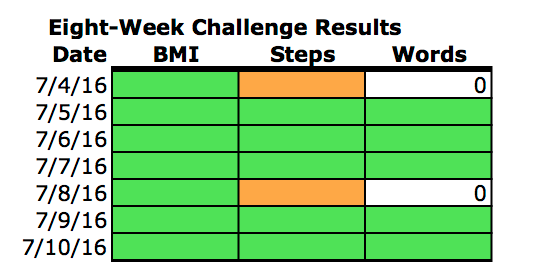
One week left! Each week one of my goals takes a back seat to something. This week the goal I was short on was writing.

As a reminder, here are my remaining goals for the eight-week challenge:

  • eat more nutritious food with fewer empty calories and
  • write at least 750 words per day for at least five days each week.

Healthy Eating

I continue to try out new vegetarian recipes–or more often just try putting vegetables together in new ways. This week I found organic strawberries and rediscovered what strawberries are supposed to taste like–so much better than the commercially grown and chemically treated bits that taste more like styrofoam than fruit.

Writing

WWIndexingEvent

My goal to write at least 750 words at least five days a week took a hit this week. Earlier in the week, the cause was too many other things on my plate–a common occurrence, according to my husband. And he’s right.

But the last three days the cause was my participation in the Family Search Worldwide Indexing Event for 2016. For those three days I reviewed scanned versions of draft records, death certificates, and lots and lots of Kentucky marriage records going back to the 1850s. Nearly every record I indexed suggested story. There were the cases of much older men marrying young women, very young barely-older-than-juvenile boys and girls marrying, even one case of a note being filed to request that a marriage license not be issued to a teenage boy and an older woman.

So many of the records of marriages in the early 1940s listed the occupation of the groom as US military. No surprise there.

All in all, I felt it was a good trade. Perhaps I’ll be able to marry up the experience with my writing goals in the future.


Ten Most Common Errors Made by Writers: #6

A Tense Moment: Word Context, Past & Present, another common error from writers, from SDW/EG member Larry Edwards.

Polishing Your Prose's avatarPolishing Your Prose

From the Editor’s Eye
The 10 Most Common Errors Made by Writers
(And How to Fix Them)

The fifth of a ten-part series.

#6. A Tense Moment: Word Context, Past & Present

You and I are sitting at a bar, having a beer, and I tell you about an incident that occurred last week, while driving home from work: At a stop light, in the car next to me, I saw a friend I hadn’t seen in ten years. Then, pointing out a little irony, I add that just yesterday I had thought of him and wondered what he’s up to these days.

You frown and say, yesterday? I’m confused. I don’t see the irony if you saw him a week ago. Don’t you mean you thought about him the day before you saw him at the stoplight? I do see the irony in that.

past-present-future-tense

And I look at…

View original post 755 more words

Book Review: Police

Five StarsPolice, the tenth and final book in Jo Nesbø’s Harry Hole detective series, tells of the Oslo Crime Squad’s search for a serial killer who is targeting them, specifically police or former police who were involved in the investigation of cases that were closed without being solved. The public are outraged at the lack of progress in the cases, though the police themselves have more reason to be concerned as some of their best have been killed. Making it even more complicated, the head of the Crime Squad is getting little cooperation from the newly appointed Chief of Police, who has his own secrets to keep hidden.
The best suspect for the crimes is presumed to have died, but as the twists come in every chapter, it isn’t certain; he may still be alive. And an anonymous patient in a coma, kept in a hospital room guarded by police day and night, is another villain from a previous Hole case, also thought to have died, whose existence serves up more threats.

Harry doesn’t make his appearance in this novel until more than 100 pages in. He has promised Rakel, the woman who captured his heart and whose life he had put in danger in the past, that he would no longer investigate cases. He traded his police status for a position as an instructor at the equivalent of Oslo’s Police Academy. He has promised Rakel he will never again put his detective skills ahead of the people in his life. He has made this promise before, but this time, he intends to keep it. That is, until it is clear he can no longer refuse the requests from his former colleagues. When one of those closest to him fell victim to the killer.

Police keeps the reader guessing all the way to the end. Nesbø offers up plenty of possible suspects as well a possible victims along the way. Even at the end, he poses questions about what is coming. Is Police really the last book in the series?

Police: A Harry Hole Novel (10) (Harry Hole Series)

Readers Write-Right and Wrong

The Sun banner

Each month, The Sun magazine offers fiction, poetry, essays, interviews, and photos in a black-and-white format without advertising. Each issue includes provocative ideas from people of science, religion, philosophy, the arts, or a combination. Each issue also includes Readers Write, a feature compiling nonfiction submissions from the magazine’s readers on an intentionally broad topic. Occasionally I submit pieces for consideration. More often, I write essays on the topics too late to submit them.

This piece should have been submitted by May 1, 2014, for consideration for the November 2014 issue.

More than 40 years ago, I lived and worked in Tehran, Iran. While there, I met several members of a Jewish Iranian family. I dated one of the younger sons of the family, Abraham, throughout the two plus years I was there.

I never expected more from the relationship–just pleasant company and someone to explain aspects of the culture that confused me. I never expected to see anyone in the family again, though I kept up a correspondence with Abraham until the Iranian revolution disrupted most communication between Americans and Iranians.

Seven years after I left Iran, while I was working as a consular officer at the US Consulate General in Stuttgart, Germany, I learned that Abraham had been arrested by Revolutionary Guards shortly after the revolution got underway. He was executed by the ruling regime. I cried myself to sleep for days afterwards.

I learned of Abraham’s death through one of his nephews, also named Abraham, who had managed to escape Iran and settle in Los Angeles with his family. Most of his larger family, including his father, Abraham’s brother, had also settled in Los Angeles. When they learned I was trying to find Abraham, the nephew gave his phone number to the person I had asked for help along with the invitation for me to call him. When I called, he pretended to be Abraham, but I knew the voice was wrong. After a few tentative comments, he asked if I had heard that his uncle had been executed by the government. I asked him who he was, and he admitted he was the “other” Abraham.

A few days after that conversation with Abraham the nephew, he called me. It was about 2 a.m. in Germany so I wasn’t really awake when I answered the phone. So when he asked me to help his wife’s aunt get a visa to the US, I agreed and then immediately realized this was not a good idea. The aunt had previously been refused a visa in another country.

I told my boss about the telephone call that morning ,and she advised that I contact Abraham to tell him I wouldn’t be able to interview his wife’s aunt, that she should instead return to the consulate where she had applied before.

Abraham tried to change my mind, referring to my friendship with his uncle and the hospitality his family had shown me. I continued to refuse, and in the end he said he would instead tell his wife’s aunt she should apply in Madrid.

In Madrid? It didn’t make any sense to me. And that made me suspicious. What was going on in Madrid that would make Abraham think it was a place his wife’s aunt might get a visa? Should I mention this strange conversation as well to my boss? Or should I just forget about it? I didn’t really know anything. I only had suspicions.

I said nothing.

A few months later, I learned that a consular officer in Madrid was arrested for fraudulently issuing visas to Iranian citizens in exchange for money.

Was I wrong not to have said something? After all, it was likely officials in Washington had already begun to suspect the consular officer given the short time between my conversation with Abraham and the officer’s arrest.

Or was I right to have said nothing since to do so might add to the grief of a family who had meant so much to me when I lived among them?


Readers Write-Houses

The Sun banner

Each month, The Sun magazine offers fiction, poetry, essays, interviews, and photos in a black-and-white format without advertising. Each issue includes provocative ideas from people of science, religion, philosophy, the arts, or a combination. Each issue also includes Readers Write, a feature compiling nonfiction submissions from the magazine’s readers on an intentionally broad topic. Occasionally I submit pieces for consideration. More often, I write essays on the topics too late to submit them.

This piece should have been submitted by February 1, 2016, for consideration for the August 2016 issue.

My grandfather made the downpayment on the house my parents moved into when they married, a one-story, two-bedroom bungalow on a quiet, two-block long street–Dudrey Court–in the county seat. The house was big enough for the first four children while we were all under ten–boys and girls shared bedrooms in those days–but my parents hoped for five children, which would be difficult to manage without a third bedroom.

Anticipating that fifth child, Dad converted the attic of the house into a third bedroom. My sister and I moved upstairs and the boys kept the downstairs room. Both rooms were now large enough for three children.

But the fifth child turned out to be twins, two boys. While the boys’ bedroom would work for a couple of years, Dad decided we needed a bigger house. I didn’t want to move. My friends lived in the neighborhood. And I really didn’t want to move to the other side of town. If we moved further south, I would have to switch schools, and that would mean not having the same orchestra teacher, Mr. Pulicicchio, I had had since fourth grade.

I don’t think my parents were eager to move from Dudrey Court either. After looking at a few houses outside the neighborhood, my dad made a decision that surprised everyone. He placed an offer on the only house on Dudrey Court that was for sale, a two-story, two-bedroom house across the street. That house was on a larger lot than our house, large enough to add two more bedrooms at the back of the house.

For another year, four of us shared a bedroom again, but this one had a walk-in closet so big my desk fit in it, giving me as much privacy as I needed. During that year, Dad added two more bedrooms, a master bedroom for Mom and Dad, a small bedroom for the twins, and once again my sister and I moved out of the shared bedroom into our own.

For more than 60 years Dad lived in one of those two houses on Dudrey Court. We kids enjoyed those houses, too, but we grew up and moved away, coming back to spend time in that second house for holidays. Grandpa made a good choice when he selected the house my parents first moved into.


Eight-Week Challenge: Week Six Results

Week 6

Six weeks into the challenge, and my progress remains positive, though always with something just beyond my easy grasp. Something worth striving for.

As a reminder, here are my goals for the eight-week challenge:

  • eat more nutritious food with fewer empty calories,
  • spend one day a week reading the backlog of magazines sitting on the end table (changed to read an average of five magazines each week from the backlog, now completed, so I’ve dropped the reporting), and
  • write at least 500 (increased to 750 since the magazine backlog is gone) words per day for at least five days each week.

Healthy Eating

I have been experimenting with ways to make my plant-based meals more interesting. For salads, I’ve added a variety of flavored vinegars including a great orange flavored one I found at Trader Joe’s. To complement it, I add orange segments to my salads, something I learned to do years ago when a church in my home area that hosted an annual spaghetti dinner found fresh tomatoes to be too expensive to use in their salads one year. They substituted oranges that year. It was so popular the church continued using oranges instead of tomatoes ever after.

Several months ago I purchased a spiralizer which I use to turn zucchini into a spaghetti substitute. Before I switched my diet, I would top the zucchini swirls with meatballs and sauce. Now, I add thinly sliced onions and julienned green peppers and stir fry them in coconut oil (long believed to be bad for health because it has saturated fat, but more recent studies indicate it has significant healthy properties). I add lentils, beans, or nuts for protein, and top it off with salsa. Today’s variety was a western salsa that included corns and black beans.

Writing

I increased my target for writing from 500 to 750 words each day at least five days per week since my magazine backlog is gone. And that is proving to be my challenge. My hope was to use the challenge to get more done on my memoir, but more often than not, I’ve been writing posts for this blog to get above 750 words. I’m pleased with having written more here, but disappointed that I can’t seem to get past the plateau I reached a few weeks back with my memoir draft.

I’m considering starting a  new project, a children’s book, instead of trying to plod on with the memoir. Perhaps I can bang some new thoughts from my brain by looking at things from a new viewpoint. And I have a built-in audience to try out the children’s book idea in our grandchildren.

Readers Write-Holding On

The Sun banner

Each month, The Sun magazine offers fiction, poetry, essays, interviews, and photos in a black-and-white format without advertising. Each issue includes provocative ideas from people of science, religion, philosophy, the arts, or a combination. Each issue also includes Readers Write, a feature compiling nonfiction submissions from the magazine’s readers on an intentionally broad topic. Occasionally I submit pieces for consideration. More often, I write essays on the topics too late to submit them.

This piece should have been submitted by November 1, 2014, for consideration for the May 2015 issue.

I was ten when my baby brother, Brian, was born. He was the younger of twins my mother hadn’t known she was carrying. Brian was just a tiny bit bigger than his older-by-four-minutes brother, so he was able to get out of the incubator and come home from the hospital first.

Since I was the oldest and already had experience babysitting my younger siblings, I felt possessive of Brian. He was the cutest baby I had ever seen. When his older brother came home, I didn’t even pay attention to him. Brian was the cute one. Bruce was the other one. And because Mom needed help when both babies wanted to be fed at the same time, I fed Brian while Mom fed Bruce.

Brian was my baby.

Because of the difference in our ages, it didn’t take long for me to leave Brian behind in favor of other interests, such as boys my own age. Ten years later, I was ready to leave home while the twins were still in elementary school. I considered them both cute by then, but they were just twerps who happened to share the same living space.

Then in 2010, my brother Brian went to the emergency room after spending a weekend at the lake with his wife and kids because he thought he had come down with a cold. He never left that hospital.

It wasn’t a cold that brought him to the emergency room. It was the early stages of pneumonia brought on by acute myeloid leukemia, AML. In his case, the A could as easily have stood for aggressive as acute because just seven weeks later, Brian was gone.

He made it through one round of chemotherapy, but the remission lasted only two weeks, not long enough for his body to regain strength for him to breathe on his own. And the tube in his throat that permitted the ventilator to keep him breathing had taken away his ability to talk–but not to communicate. He used a board with letters to spell out words. Or he whispered.

During his seven weeks in the hospital, Brian taught me three things through his example. He taught me the importance of saying thank you. He taught me the importance of saying I love you. And he taught me the importance of maintaining a sense of humor.

Brian knew he was dying. He had plenty to complain about, but he didn’t complain. When the nurses came into his room to give him a shot or to take a glucose reading or to change the bedpan, Brian always whispered, “thank you,” before they left the room.

Brian had plenty to be angry about, but he never expressed anger. Whenever someone came to visit him, whether family or friend, whether the visit was one time or every day, Brian always whispered, “I love you,” before we left his room.

Brian couldn’t eat or drink anything. Tubes delivered both food and water. What he wanted most of all was a drink of cold water. And whenever a doctor or nurse asked him if there was anything else they could do for him, he would whisper, “I’d like some water, please.”

I can’t let go of Brian. His name is still in my iPhone directory. When I want to talk with his wife or his daughter, I look up Brian’s name to get the number. I have a folder in my GMail account where I keep all the messages he sent me. It also contains eight messages that arrived several months after he died, the result of someone having hacked his old account. I’ve never opened them, but the previews include statements I can just hear Brian saying, if he ever got his voice back:

“hey Sandra, I told myself to stay positive at first. . .”
“hey there Sandra, I found something that could change how you live. . .”
“hey there Sandra, I wanted to prove I could amount to something. . .”

I will hold on to those messages in order to hold on to Brian.

What are you holding onto?