Æ is for Æsir

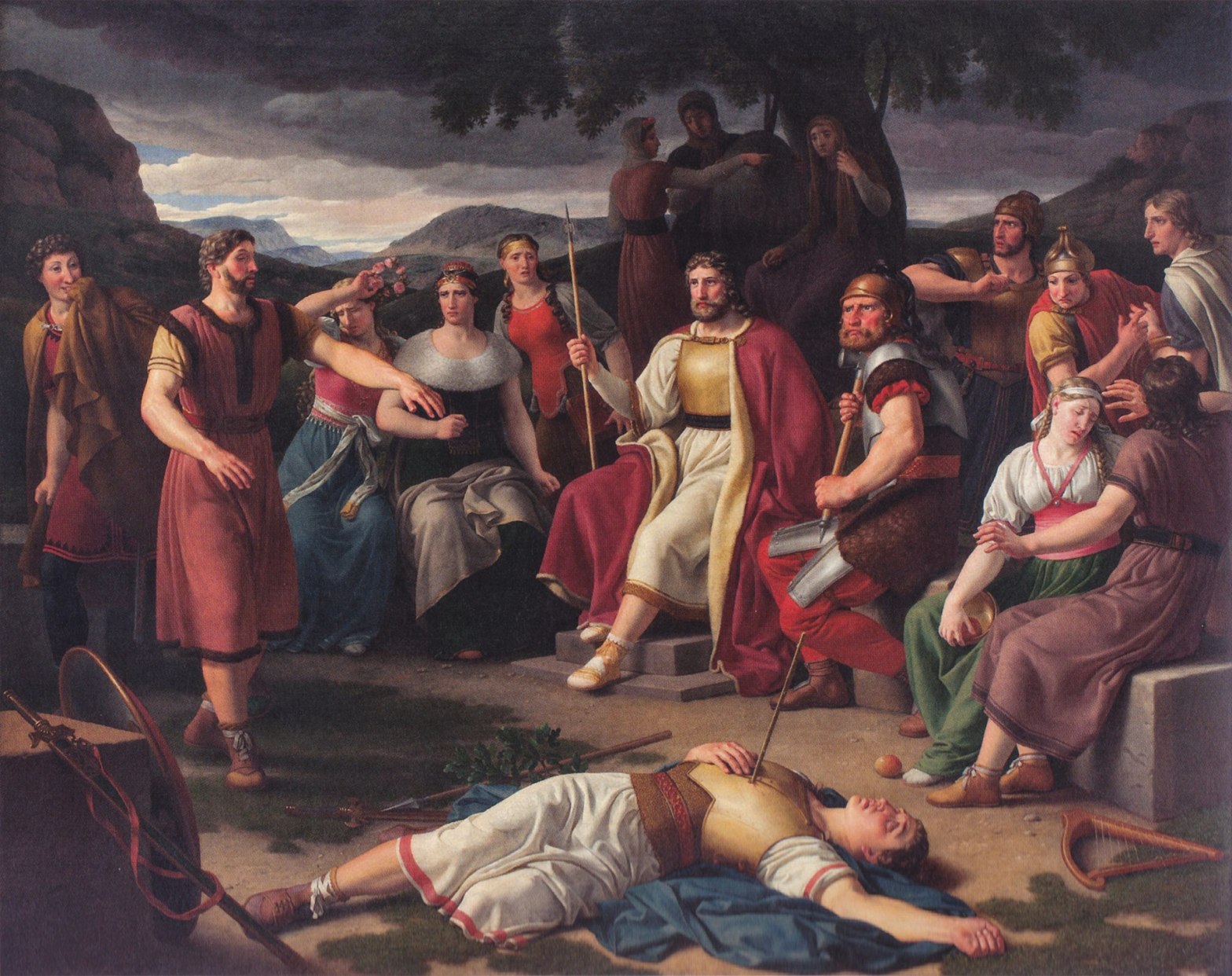
The Aesir (pronounced “ICE-ear”; Old Norse Æsir for multiple gods, Ásynjur for multiple goddesses, Áss for one god, and Ásynja for one goddess) were one of the two main tribes of deities venerated by the pre-Christian Norse and other Germanic peoples. (The second tribe was the Vanir). Most of the best-known Norse gods and goddesses belong to the Aesir, including OdinThorFriggTyrLokiBaldurHeim-dallIdun, and Bragi. Their home is Asgard, one of the Nine Worlds, which is located in the highest, sunniest branches of the world-tree Yggdrasil. In the Norse sources, Odin, the “Allfather,” is their chief. However, this is likely a relatively late development, and several convergent lines of evidence suggest that this role was originally occupied by Tyr.

–from Norse Mythology for Smart People by Daniel McCoy

The Norwegian letter Æ falls after Z in modern Norwegian, but since the Aesir are such an important part of Norse mythology and yesterday’s post was about their home, Asgard, I’ve moved the letter to second place in the A to Z Challenge.

It is nearly impossible to describe the Aesir without referring to the second clan of Norse gods, the Vanir. What’s the difference between the two groups? Some scholars consider the Vanir to be gods in the realm of agriculture and fertility while the Aesir are gods of war and conflict. Perhaps this reflects a struggle of classes in ancient Europe.

What is clear in Norse mythology is that the Aesir and Vanir battled with the result that some of the Vanir became hostages to the Aesir. That makes it difficult to be sure which gods belong to which clan.

A great visual resource for referencing which gods are Aesir, which are Vanir, and which other mythical creatures are giants or humans can be found here. The image is copyrighted or I’d include it here. The creator has produced a poster which I have ordered for the House of Norway in Balboa Park here in San Diego.

Some ancient religions or mythologies refer to a greater and a lessor set of gods or a an elder and a younger set. Ancient Greece, for example, had both the original Titans and the later generation of Olympians.  The Aesir and Vanir, however, were co-equal, each reigning over separate aspects of the world. After the Aesir-Vanir war, the two clans of gods united into a single pantheon. From now on, I won’t worry about which gods are Aesir and which are Vanir unless it is absolutely clear or necessary. They are all gods and ruled together after the war.

Because Norwegian orthography spells vowels with letters or diacritical marks not in the English alphabet, many names represented in English with the prefix “Os-” are related to the word Aesir. The family name of one branch in my family tree tree is Oss. I now wonder if it represents the masculine singular form of Aesir. (There might be a simpler explanation; the word oss also means we or us.) Other family names related to this prefix, such as Osgood, Oswald, and Osborn, are related, according to this Wikipedia article, though it lacks authoritative sources. Even some first names, both men’s and women’s, such as Oscar, Astrid, and Aslaug, carry the prefix.

Because place names provide clues to an area’s history and culture, I’ll be looking at place names during our travels in Norway to see how many of them I think are related to Aesir. More grist for conversations as my sister and I travel around Norway.

Image credit: By Christoffer Wilhelm Eckersberg – Self-scanned, Public Domain, Link

A is for Asgarðr

Asgard (Old Norse Ásgarðr, “Enclosure of the Aesir)” is one of the Nine Worlds of Norse mythology and the home and fortress of the Aesir, one of the two tribes of gods (the other being the Vanir, who have their home in Vanaheim). Asgard is located in the sky[1] (albeit spiritually rather than physically, of course) and is connected to Midgard, the world of humanity, by the rainbow bridge Bifrost.

–from Norse Mythology for Smart People by Daniel McCoy

My first memory of hearing the word Asgard is not from having heard fairy tales as a child, though I grew up in an area and at a time when nearly everyone around me descended from Norwegian immigrants. The first time I recall hearing the word was while watching an episode of the late-1990s TV show Stargate SG-1.

In Stargate SG-1, Asgard referred to people, not a place, and the Asgard High Council consisted of a group of clearly important people. That is the connotation I took away from the SG-1 references. Asgard, whatever the word refers to, is important.

Norse mythology, with all its gods, giants, magical tools, and mystical places, has become entwined in many aspects of popular culture. In Neil Gaiman’s 2017 book, Norse Mythology, the author renders the myths and tales in contemporary language that tell a comprehensive tale of how the gods and their followers strode on and interacted with the beings that fill the nine-level cosmology of Norse mythology. Other examples of how Norse mythology is being tapped for story telling include the obvious, such as the TV show, Vikings, as well as not so obvious references in Jim Carrey’s movie, The Mask, in which the mask he dons changes his life dramatically due to its possessing the powers of Loki, the trickster of Norse mythology.

Dozens of video games involve characters or themes that trace back to Norse mythology. Comic books, graphic novels, and manga and anime in the United States, Europe, and Asia also feature Norse mythological characters. Marvel Comics’ Avengers series include Thor as a hero and Loki as a villain. Gaiman incorporated mythic elements in many of his novels before he delved into providing the source for those elements in Norse Mythology. J.R.R. Tolkein’s works rely on Norse mythology for the descriptions of his human-like, but not human, characters, such as elves, dwarves, and hobbits. Dozens of books going back to as early as 1890 borrowed characters or themes or even entire story plot lines.

I know my parents read me fairy tales with a connection to Norway and the rest of northern Europe when I was a child. Perhaps all those stories with references to gods and goddesses had been removed because they might be confusing to a child being raised in a Lutheran church who attended Sunday School every week during the school year. Perhaps that’s why I never heard of Asgard. I heard, instead, of heaven. Unlike Asgard, in the Christian tradition, heaven isn’t just a place for God. It’s a place, to use Daniel McCoy’s words, albeit spiritual rather than physical, that I can hope to go.

Do I expect to find Asgard on my trip to Norway. Of course not. But I will be listening and watching to see if I hear anyone mention it or see anything in either words or images. And that will give me a starting point for a conversation.

[1] The Poetic Edda. Grímnismál, stanza 13.

Image credit: By Image extracted from page 039 of Histoire des peuples du nord, et des Danois et des Normands, by WHEATON, Henry. Original held and digitised by the British Library. Copied from Flickr. Note: The colours, contrast and appearance of these illustrations are unlikely to be true to life. They are derived from scanned images that have been enhanced for machine interpretation and have been altered from their originals. This file is from the Mechanical Curator collection, a set of over 1 million images scanned from out-of-copyright books and released to Flickr Commons by the British Library. View image on Flickr   View all images from book   View catalogue entry for book |   Public Domain Link

A to Z Challenge Reveal: Norse Mythology

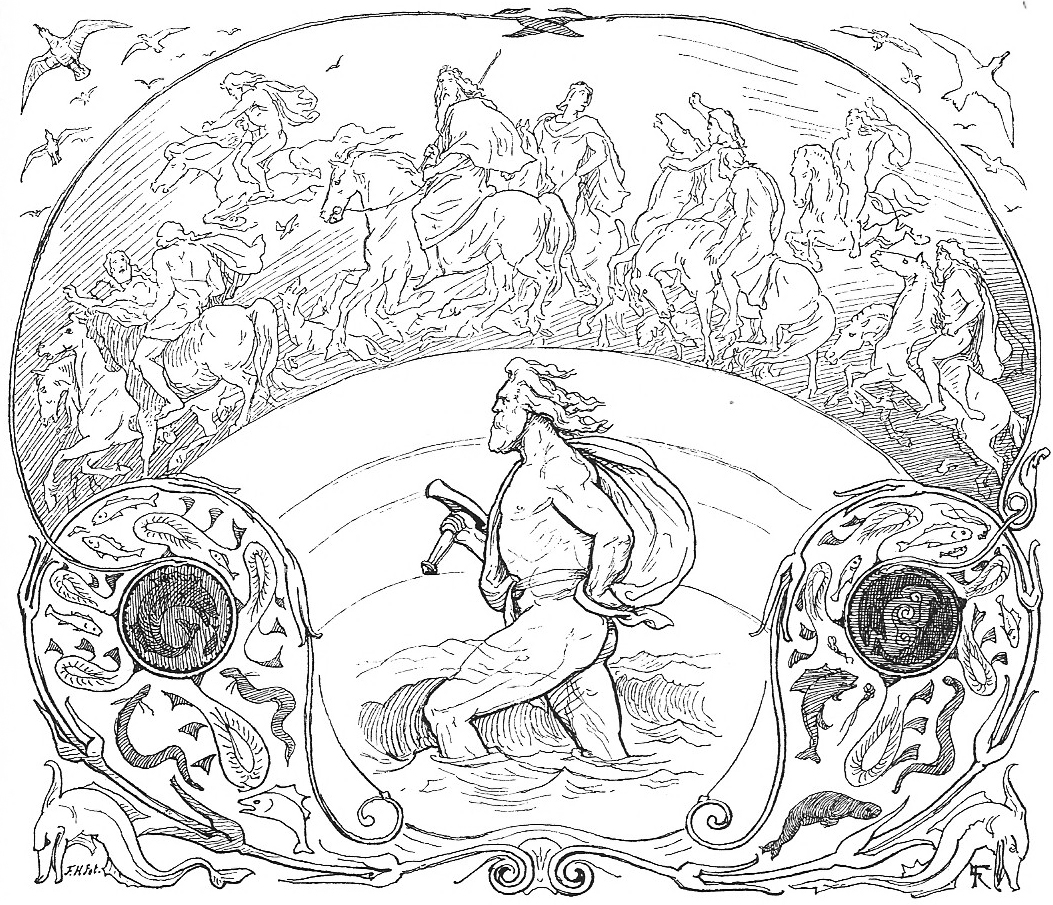
[Caption for above: The god Thor wades through a river while the Æsir ride across the bridge Bifröst in an illustration by Lorenz Frølich (1895)]

This year I am once again taking part in the April A to Z Blogging Challenge. And today is my Reveal for 2018: Norse Mythology.

My reason for taking on the topic for this year’s challenge is that my sister and I plan to travel to Norway soon. I decided to research Norse mythology to see if there are themes or topics from mythology I should be aware of as we travel through Norway.

Having been raised in a largely Scandinavian community, I heard many stories from Norway, but at the time I had little realization where the stories came from. I assumed that the stories I heard at bedtime, or that our elementary school teachers read to us in the classroom, were the same ones children all over the United States heard.

I encountered words, phrases, and things around me that I didn’t realize were Norwegian. If I attributed any characteristic to them, it was likely that I thought they were old-fashioned.

At a young age I noticed that nearly every person of my grandparents’ age spoke with a distinctive accent. I am embarrassed to admit how old I was before I realized that accent was Norwegian–or maybe Swedish–and that I wouldn’t grew into using it as I aged.

My travels around the world brought me in contact with traditional stories from many cultures–from the Caribbean to Eastern Europe to the Middle East. It’s time I come to a greater understanding of the traditions of my own ethnic and cultural background.

I do not pretend that I can explain everything about Norse mythology. For detailed understanding, see works such as Neil Gaiman’s Norse Mythology, or Daniel McCoy’s website, Norse Mythology for Smart People. My posts will all begin with a quote from McCoy’s website, where he states, “You’re of course free to quote, cite, or link to my work as you please, as long as you don’t plagiarize. No need to ask.” I hope you’ll check his site for more information about the gods, mythical creatures, and tales through the links I will provide.

Many important words in Norse mythology begin with letters that are not in the English alphabet. In addition, there are some English letters that I just couldn’t find good words to represent because there are no indigenous Norwegian words that use C, Q, W, X, and Z. Don’t be surprised, therefore, that I will skip those letters, plus P. To make up for them, I will add multiple entries for some letters as well as entries for Norse letters, Þ and Æ. Each entry will use the Old Norse spelling of the word, though most of the text will use the standardized English spelling beyond the introductory quotation.

My goal is to use the characters and stories from Norse mythology to make observations on lessons for my life. The more I understand of myself, the more I hope to understand others. I hope you’ll join me on this personal adventure.

Image credit: By Lorenz Frølich – Published in Gjellerup, Karl (1895). Den ældre Eddas Gudesange. Scanned from a 2001 reprint by bloodofox. Public Domain, Link

Zarathustra aka Zoroaster

Last week I attended a lecture at OASIS in San Diego on Zoroastrianism. I worried that there might not be enough interest in the topic for the lecture to be held. I hadn’t preregistered because I am on call for jury duty this month so I couldn’t commit to attending.

When I arrived, I was delighted to discover more than two dozen people had registered. My assumption that few people in the area knew anything about the subject–or were interested in learning more–was banished.

My interest stems from having arrived in Tehran, Iran, in April of 1975, at the tail end of the ten days of celebration for Nowruz, the Persian new year. And I learned that the observation of Nowruz goes back to the time of Zoroaster, also known as Zarathustra.

I thought I already knew a lot about Zoroastrianism, having not only observed Nowruz celebrations in Iran but also having visited the sites of some of the earliest Persian fire temples near Persepolis in southwestern Iran. Fire serves as a symbol of the religion, perhaps because the underground natural gas reserves made it possible for flames to continue burning without the need to add fuel.

Also I could recognize, for example, the farvahar, a symbol of Zoroastrianism carved into the rocks near those same sites, as seen in the image at the top of this post. I knew–or thought I did–that Zoroastrianism is (there are still followers around the world) a dualistic, not monotheistic, religion in which two gods, Ahura Mazda, the god of good, and Angra Mainyu, the god of evil, are in a constant struggle. Okay, I only remembered the name of Ahura Mazda, but I knew there is also a name of the force of evil, and I looked forward to being reminded of it. Many scholars believe the dualist aspect of Zoroastrianism was imposed later, that originally Ahura Mazda was the only god, as in monotheistic religions, with Angra Mainyu serving as an opposing, but not equal, force. This is the opinion of the lecturer.

I also knew that Iranians consider Zoroastrians among the people of the book, a term used in Islamic literature to identify those non-Muslims who were to be protected under Islam because they also follow a monotheistic belief system including an end-of-day’s judgment that will separate the good from the evil and that the belief system has been written down into a sacred text. But I thought the dualism I understood to be part of Zoroastrianism wouldn’t qualify. I also knew nothing about a Zoroastrian sacred text.

I learned that what I didn’t know about Zoroastrianism would fill volumes while what I knew that was accurate would fit on a the back of a postage stamp. Let me explain some of the surprising aspects of Zoroastrianism I learned from the lecture.

First, I learned the basic principles of Zoroastrianism: good thoughts, good words, good deeds. I recognize them as consistent with Judaism, Christianity, and Islam and perhaps a few East Asian religions.

Second, I learned the the symbolism of the farvahar and was reminded of how important a role symbolism plays in my 21st century Christian life.

The three bands of feathers in the wings of the farvahar represent the three principles: good thoughts, good words, good deeds. The three bands in the skirt of the human depicted on the farvahar represent the contrasting ideas: bad thoughts, bad words, bad deeds. The challenge is to keep them in balance. The circle the figure appears almost to be riding on represents the immortality of the spirit. The two sashes that end in loops or claws below the circle represent good and evil with the representation of good on the side the figure is facing and evil behind it. One of the figure’s hands points upward, representing struggle. The other hand holds a ring which may represent loyalty and faithfulness.

Third, the lecturer pointed out that Jews during the Babylonian captivity would have encountered Zoroastrianism and its rituals and traditions, many of which may have been adopted when they returned to Judah after the Persian king Cyrus the Great defeated the Babylonians and released the captive Judeans. I knew that not all the Judeans returned since a remnant of those who stayed behind made up the Iranian Jewish population I met while I was in Iran. There I learned that Esther of the eponymous Biblical book married Xerxes I, the fourth ruler of Persia after Cyrus the Great, a reflection that Jews remained in Persia for many generations after they were permitted to return.

Some of those traditions include the expectation that a messiah will come to the earth, that people will face judgment after death, the concept of heaven and hell, and free will.

Fourth, Zoroastrians referred to their priests as magi. Therefore, the three kings who traveled from the east to visit the baby Jesus were likely Zoroastrians.

Fifth, the Zoroastrian scripture is the Avesta which contains four segments:

While the above may be interesting, they are all just details from the lecture.

The more important lesson is that history goes back further than we sometimes want. We can’t just draw a line in our past and claim anything that happened before that date is no longer important. We cannot simply reset history.

If we stop studying history from the earliest point at which the conditions are consistent with what we believe is right or ideal, we will not understand how interrelated we all are, how our ideas have antecedents that we should understand before we insist we are right and everyone else is wrong. If we want to understand others, we should go back in history to find what we share, what we have in common, in order to bring those ideas forward.

Happy Nowruz which falls this year on March 20.  Saale no mobaark.

Photo credit: By Napishtim – Own work, CC BY-SA 3.0, Link

Mărțișor, My Romanian Valentine’s Day

Alexandru Ioan Cuza University in Iași, Romania, served as my home for the 1977-1978 academic year. Life in Romania was simpler than life had been in Iran the two years before. Whenever I heard one of my American colleagues complain about something uncomfortable in Romania, such as having to wait in so many long lines, I could usually respond with “Yeah but, at least here you’ll eventually get to the front of the line.” I made a lot of “yeah but” statements that year.

Autocratic rulers governed both countries: the Shah in Iran and Nicolai Ceaușescu in Romania. And while the Shah’s government considered anyone with communist leanings the enemy, and Romania was a communist country, similarities exceeded differences. In both countries people lived in fear of the secret police. The people in both countries were ethnically different from those in the countries that surrounded them, the perfect setup for feeding people’s fears of “the other.”

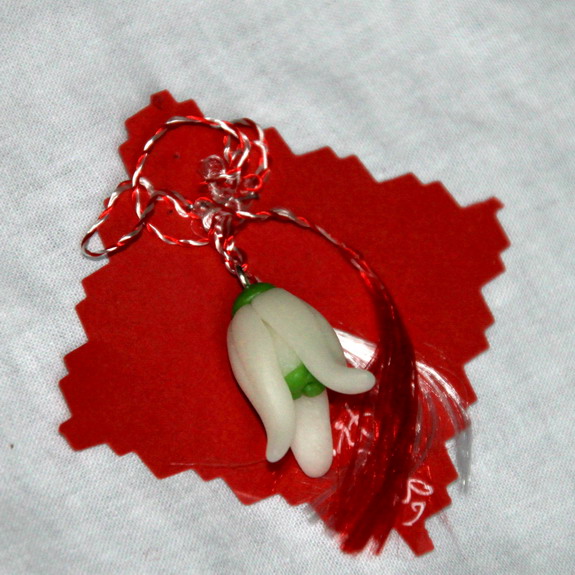
Because of those similarities, life in Romania was still a long way from comfortable for me. At least until March 1, 1978, the celebration of Little March, or mărțișor, in Romania.

Before March 1, I spent most of my time thinking of when I could leave and return to the United States. As much as I loved the challenge of adjusting to life in different cultures, I was surrounded by unhappy people in Romania. And their unhappiness spilled into my life. Romanians seemed to accept disappointments as unavoidable, the way things are, instead of looking for improvements.

But most of all, I rarely saw a Romanian smile. We used to joke that if two Romanians were caught laughing on the streets, a policeman would arrest them because they must be doing something that wasn’t allowed.

Then, on March 1, everything changed. As I went from class to class, my students presented me with charms hung from one red and one white thread, twisted together. They pinned the charms to the lapel of my coat with straight pins, one from each student.

By the end of the day, little of my coat lapels could be seen. But more significantly, my jaw ached from smiling so much as I returned the smile of each student who pinned their martisoare (the plural form) on my coat.

For the first time, I felt the students appreciated my presence, or in Sally Field’s words, they liked me.

It was as though I had been given a new pair of glasses, with rose-colored lenses, through which I could see clearly. What had seemed drab during my first six months suddenly had color. The students who had seemed lethargic now took part in discussions with enthusiasm.

I compared mărțișor to a child’s Valentine’s Day, that time when elementary school classmates would not only give a valentine to every other child in the class, but also a special one to the teacher.

In each country I have since lived, I have looked for a little thing–an item, action, or place–to serve as a reminder that I always have a choice in how to view my surroundings, keeping my eye on the positive. For example, in Germany I set out to find a poor German restaurant (I failed). In Qatar I searched for the best chocolate mousse. In Barbados I watched out for the perfect sunset.

I’ll take Pollyanna’s rose-colored glasses any day over ones that pinch or obscure the view.

Photo credits:

Featured image: By Ella Nicuta Some rights reserved

Snowdrop By AndreirusanOwn work, CC BY-SA 3.0, Link

Barbados and the Mongoose

We had a cold snap this week in San Diego, so my thoughts turned to one of the countries I lived in that was never cold: Barbados.

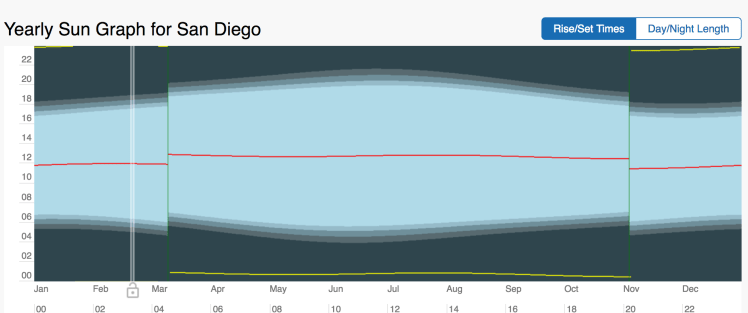
The temperature in Barbados was always warm, between 70 and 90 degrees Fahrenheit. The average daily high temperature is 86 degrees. In fact, I suffered from a serious sunburn my first week in the country–in December of 1989.

The variation in the number of hours of daylight is very slight. Check out the chart below which shows in light blue the hours the sun shines over the course of a year–from approximately 6:00 a.m. to 6:00 p.m. every day.

And compare it to a chart showing the same data for San Diego, CA, my current home, where the sun comes up between 3:00 a.m. and 6:00 a.m. (adjusted for daylight savings time) and goes down between 4:00 p.m. and 7:00 p.m. (adjusted for daylight savings time):

Back to Barbados. The days are about the same length every day of the year, and the temperature also varies little from one day to the next. Time seems to move very slowly.

There is little difference between summer and winter, making it difficult for the season to help jog memories of when something happened. That further distorts the sense of time passing, blurring one year into another.

One of the most interesting explanations I heard of how past events both seemed recent and served as reference points came from a St. Lucian woman who applied for a visa to the United States in Barbados. She told me she had last traveled to Barbados “a few years ago,” which I interpreted as being two or three years. But when she mentioned it was just after her daughter was born, I asked how old her daughter was. Her response was along these lines: “She was born the year they stopped the mongoose from Barbados.” That was approximately 18 years earlier, a considerably larger number than my assumption of what “a few years ago” meant.

Barbados imported mongooses from India at the end of the nineteenth century in an attempt to eradicate rats, which were feeding on sugar cane, the country’s most important agricultural crop. Unfortunately, rats are nocturnal, and mongooses are not. Instead of feeding on the rats, since they were not out and about at the same time, the mongooses ate snakes, the natural enemy of the rats, leaving the island with no snakes and an ever-increasing rat population.

Some mongooses still survive in Barbados. Our intrepid cat, Sharifa, tangled with one and came out on the losing side. If we hadn’t seen her streak through the french doors to hide under the sofa where she probably would have stayed and gone into shock, we might have lost her, according to the vet next door. He patched her up and kept her overnight for observation. That vet saved her three times. First after the mongoose attack. Second when she tangled with a centipede when the bite swelled up her neck so much that she looked like a short-eared rabbit. And finally when he stopped one of his other customers from driving away while she sprawled out, sunning herself in the car’s back window.

It is understandable that the government decided to stop the importation of mongooses from other Caribbean islands.

To explain why “the year they stopped the mongoose from Barbados” was important to the St. Lucian woman, you must understand her profession: She was a solicitor.  This did not mean a lawyer. Solicitors in the islands brought goods from one island to a second one, where they sold what they brought, bought what was available on the second island, traveled to the next island and sold what they brought, continuing from island to island until they returned home, hopefully with more money than they left with.

The St. Lucian woman had stopped her itinerant solicitation business when she gave birth to her daughter, the same year Barbados outlawed the mongooses that she previously brought there to sell “for food,” she said.

Photo credits:

tortoise featured image: Cédric Frixon

Mongoose 

A Twist on Valentine’s Day

Valentine's Day heartsEvery year February 14 is Valentine’s Day, a Hallmark holiday that traditionally includes cards, chocolates, flowers, and often dinner out and perhaps a new bauble or other token of affection.

Ash cross on woman's forehead

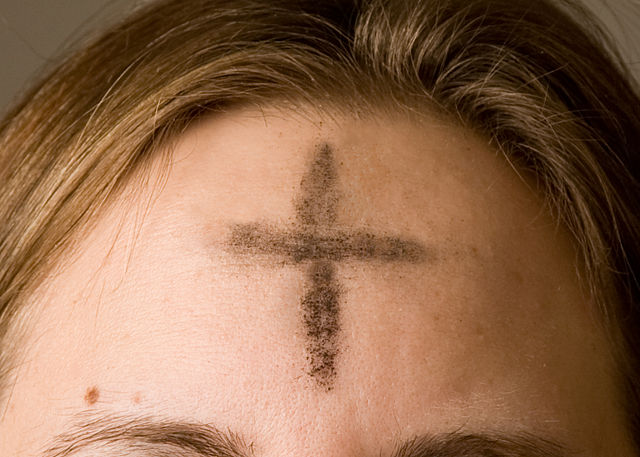
This year February 14 is also Ash Wednesday, a Christian holiday that marks the beginning of 40 days of fasting in preparation for Easter, the most important holiday in the Christian calendar.

That coincidence of the two holidays gave me inspiration to look for a way to observe both of them in some compatible way.  A way to move from a strictly Hallmark holiday to a holiday in the spirit of II Corinthians 13, often referred to as the Love chapter. The last verse may be the most well known: So faith, hope, and love abide, these three; but the greatest of these is love.

Don’t get me wrong. I’m not forgetting my husband on this day of romance. He will receive a card with just the right sentiment, selected after 45 minutes of sifting through cards with texts ranging from syrupy sweet to barely appropriate humor. He deserves the perfect card. Each year I search for it. He is the reason my life is so rich I can think of ways to be generous to others–to share faith, hope, and love with others.

The specific inspiration for the twist came from alerts of new Internet stories about the countries I have lived in. Reviewing them keeps me in touch with a variety of aspects of life–political, cultural, religious–in those countries. The posts I received most recently about Madagascar gave me an idea for the twist.

Before I describe it, I’d like to introduce readers to Madagascar. Briefly.

Madagascar is the world’s fourth-largest island. The curves of the west coast of Madagascar match the curves of the east coast of the African continent, just to the west. Without the benefit of more detailed knowledge of how the supercontinent of Pangea rifted, it’s reasonable to assume the island broke away from Africa, but it’s more complicated. In fact, the land that corresponds to the island of Madagascar broke away along with a larger landmass that eventually moved northward and collided with what became the continent of Asia. That collision formed the Himalayan Mountains at the northern edge of the Indian subcontinent. During that land migration, the island of Madagascar broke away from the northward-moving landmass and drifted back toward Africa. Wikipedia includes an animation of the breaking apart of Pangea which shows these rifts and movements.

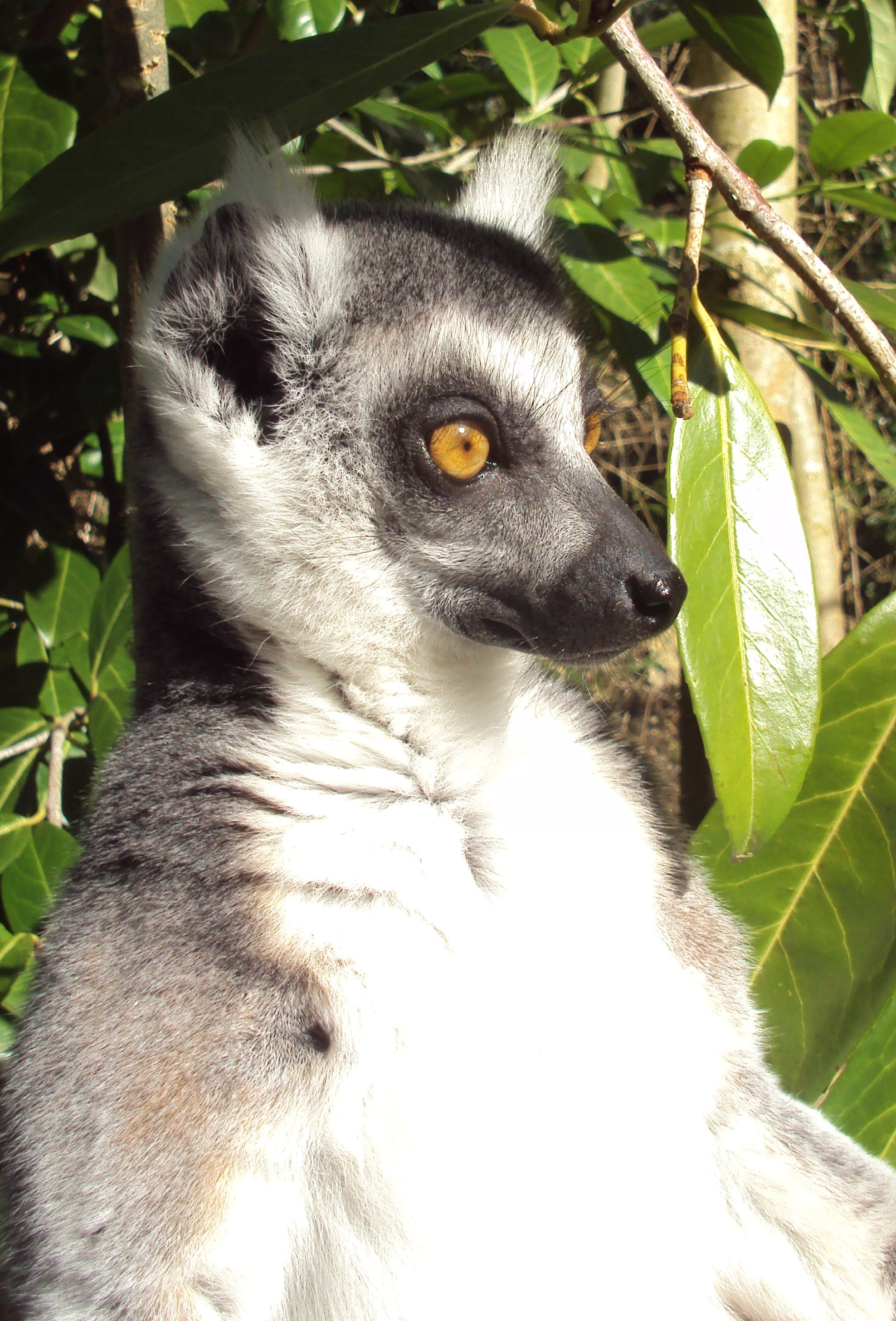
lemur sunning himselfThe extended period of time that Madagascar drifted first away from Africa and then back again resulted in the incredible variety of unique plants and animals of Madagascar. My favorites are the lemurs, ranging in size from as small as a mouse to as big as a baboon. Dream Works’ Madagascar film franchise helped popularize the lemur I believe is most widely recognized: the ring-tailed lemur. Distressingly, Scientific American reported in January that the ring-tailed lemur population has plummeted 95% since the year 2000.

Lemurs are not all that Madagascar is losing. The agricultural practice of slash-and-burn has contributed to the loss of 90% of Madagascar’s forests. But the practice has more than agricultural significance. Because the ash left behind after the burning enriches the soil, the practice has cultural value as it is associated with wealth and prestige, a powerful combination of motives difficult to overcome.

red silt in the rivers of MadagascarA secondary loss from the slashing and burning is the erosion of the soil which settles as red silt in the rivers and flows into the ocean, making it look as though the island is bleeding.

Economically, Madagascar in 2016 was identified as one of the world’s fastest-growing economies. But that doesn’t tell the whole story. The average annual income in Madagascar is only $1,000. Madagascar’s agricultural industry, including fishing and farming, employs 82% of Madagascar’s labor force. Other industries–including textiles, mining, and tourism–are growing, but a combination of factors including food insecurity, fluctuations in investment from outside, and political instability have made for a rocky road. In its 2002 election two candidates, the then long-serving president, Didier Ratsiraka and a challenger, Marc Ravalomanana, claimed victory, which led to a political crisis, resolved eventually in favor of the challenger. But seven years later, the military took over. Elections were reestablished in 2013. Since then, Hery Martial Rajaonarimampianina has served as president.

The idea for my Valentine’s Day twist came from the several alerts about people in Madagascar who had received micro-loans from Kiva.org, an international nonprofit, founded in 2005 and based in San Francisco, with a mission to connect people through lending to alleviate poverty. It is possible to loan as little as $25 to a project through Kiva.

Here’s my proposal: In addition to following whatever romance traditions you have established with those special people in your life, consider sharing your faith, hope, and love through a small loan with Kiva to someone in another part of the world–or even to someone within the United States–to be part of another person or family realizing their dreams.

I have added my contribution to the loan requests of Clarisse and Ernest of Madagascar.

Photo credits:

Transnistria: Just One More Little Country You Probably Haven’t Heard Of

This week I posted a video about Transnistria, a country in limbo at the edge of Europe, on Facebook. The reaction made me realize I haven’t done enough to tell my personal story about living next door to Transnistria.

Here is my story, Traveling Through Transnistria, as published in the Third Edition of The Guilded Pen, the San Diego Writers and Editors Guild 2014 anthology of work by its members.

Traveling Through Transnistria
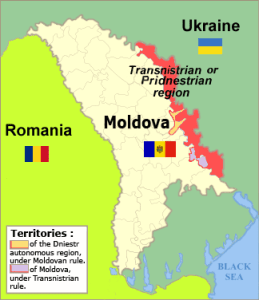
Map of Transnistrian areaWhen the former Soviet Union broke apart in 1992, Transnistria, a sliver of land at the eastern border of Moldova, right next to the Ukraine, wanted to be part of Russia, not Moldova, in spite of the fact that nearly 800 miles separated it from the closest point within Russia. Transnistria continued to use the Russian ruble even after Russia had issued new rubles and stopped accepting the old-style currency as legal tender. The Transnistrians added a postage stamp to the Russian rubles to indicate they were their currency.

Since the collapse of the Soviet Union, Russian troops have been present in Transnistria. At the time my husband, Alex, and I were in Moldova, from 1992 until 1994, General Alexander Lebed was in command of the Russian 14th Guards Army in Moldova. Border skirmishes were frequent between Moldova and Transnistria. However, travel across the border was common and somewhat safe. So, I was delighted when Alex and I were invited to participate in one such transborder excursion.

The Organization for Security and Cooperation in Europe (OSCE), charged with facilitating a negotiated settlement between Moldova and Transnistria, has had a presence in Moldova since the early 1990s. At the time we were in Moldova, the ambassador from the OSCE to Moldova was a Canadian. One weekend, he, his wife, Oksana (one of his local staff), the US Ambassador to Moldova, Mary Pendleton, Alex, and I set off for a relaxing few days in Odessa, on the Black Sea coast of the Ukraine.

We left Friday afternoon in two cars. Ambassador Pendleton, Alex, and I were in one car. The OSCE ambassador, his wife, and Oksana were in the other car, in the lead so Oksana could translate. She was to explain to the guards at the Transnistrian “border,” recognized by neither the US government nor most European nations, why we needed to be given speedy and unimpeded passage through Transnistria to the Ukraine.

Ambassador Pendleton had one condition for this trip—that we must cross Transnistria during daylight. She agreed to the OSCE ambassador’s plan with the understanding that we would return from Odessa in plenty of time to reach the border by 5 p.m.

Oksana had been a university student in Odessa and very eager to show us what Odessa had to offer.  Getting us through the Transnistrian checkpoint was not a problem she assured us. And, just as promised, at the border, Ambassador Pendleton in the follow car was waved through without having to stop.

Once we reached Odessa, we checked in at a private sanitarium at the edge of the city. The name conjured up visions of patients with tuberculosis or schizophrenia, but Oksana explained that the sanitarium had rooms that were converted to accommodate travelers and was a place that offered a relaxing and calming setting. We were the only guests that weekend.

That evening we headed for a meal at a restaurant overlooking the coastline and beach. We found our favorites on the menu, pelmeni (meat-stuffed dumplings smothered in sour cream), cabbage rolls (meat-stuffed cabbage leaves smothered in sour cream), carrot and raisin salad smothered in sour cream. The restaurant was full of very well-dressed, cosmopolitan young couples, some of whom looked as though they had just walked out of a stylish European casino. They were the local businessmen who had quickly figured out how to make money in the new capitalist economies of the Commonwealth of Independent States (CIS), the loose confederation of the former Soviet republics. Most citizens of CIS states considered all businessmen to be part of the Russian mafia. The well-dressed couples made that lifestyle very attractive.

The next day we toured several museums, many of them with a strong military slant. We also went to see the Potemkin steps, originally 200 steps leading from the city situated on a high steppe plateau to the harbor. The steps are now known more for Sergei Eisenstein’s use of them in his 1925 silent film, Battleship Potemkin, about the 1905 massacre of sailors and city residents.

That evening we went to an organ concert where one of the most noticeable acknowledgements of the change in the government was the hole in the flag on the stage curtain where the hammer and sickle had been.

After the concert, Oksana suggested we go to a hotel that was well known for its entertainment.  As she had done at nearly every other stop, she chose that we not park directly in front of the location where we intended to spend our time. Instead, she had the OSCE ambassador drive around the corner from the hotel to locate two parking spots so that the two cars would be parked one in front of the other. I didn’t ask why we didn’t park in front of the location; I just wondered. I should have asked; I didn’t realize why until later.

The next morning, Sunday, and our last day in Odessa, Oksana recommended we have breakfast at a famous downtown restaurant, Varadero, which offered tables along the open windows overlooking the wide veranda, before we headed a short distance out of town to see another Ukrainian Black Sea site.

Although there were plenty of parking spaces directly in front of the restaurant on a very wide sidewalk where others parked their cars, Oksana, again, took us around the corner to park the two cars out of sight, and we walked back to the restaurant.

At the end of the meal, we returned to the cars. As we turned the corner, something was wrong. There was only one car on the street, Ambassador Pendleton’s Honda. The OSCE ambassador’s Lada was missing.

Instead of spending a short time at the other resort after which we planned to travel back through Transnistria, arriving at the border while it was still daylight, we ended up back at the restaurant. Oksana called the police.

Gasoline was in very short supply in all of the former Soviet Union at that time. After speaking with the police, Oksana informed us that if we wanted someone to investigate the missing car, we would have pick-up a policeman in our remaining car. The police had no gasoline.

Ambassador Pendleton, the OSCE ambassador, and Oksana headed out to the police station, leaving the OSCE ambassador’s wife, Alex, and me behind.

Once the policeman was on site, he seemed optimistic the ambassador’s car would be found. He recommended that we just wait. In the meantime, Ambassador Pendleton, the OSCE ambassador, and Oksana drove the policeman around, making several other stops so he could file the reports and investigate options.

By 3 p.m., Ambassador Pendleton was concerned that if we didn’t leave soon, we would arrive at the Transnistrian border at dusk.

“We need to leave,” Ambassador Pendleton said.

“Don’t worry,” Oksana reassured us. “I know a short cut that will get us to the border quickly. We don’t have to rush yet. Let’s wait to see if the police can find the car. Besides, there are six of us. We can’t all fit into one car.”

“We can squeeze four people into the back seat,” the Ambassador countered. “It won’t be comfortable, but it will be safer than waiting.”

“The policeman is sure they will find the car soon,” Oksana insisted.

We gave in and agreed to wait. By 5 p.m., Ambassador Pendleton decided waiting any longer was out of the question.

“We can’t wait any longer,” Ambassador Pendleton insisted. “We have to leave now.”

“If you must,” Oksana said. “The ambassador and I will remain here until the police find the car.”

With that, the four of us–Ambassador Pendleton, Mrs. OSCE Ambassador, Alex, and I–piled into Ambassador Pendleton’s car. Now minus the only Russian speaker among us, we headed for the border taking the shortcut Oksana recommended as we watched the sun sink lower and lower. By the time we reached the border, daylight was nearly gone, and it became obvious that we might have trouble. The guards were not in identifiable uniforms. Most of them were very young men, and it was clear that they had been drinking all afternoon.

When we stopped, a guard stumbled as he walked towards the car. His rifle was slung over his shoulder while the other guards were holding their rifles by the barrels, resting the butts on the ground, like walking sticks. This behavior did not instill confidence. The ambassador rolled down the window and showed him her passport. We sat back, trying not to convey our nervousness.

The guard insisted the ambassador get out of the car. She tried to speak with him in Romanian. Ignoring her attempt, he motioned for her to go to the back of the car and he pointed to the trunk, indicating she should open it. She did. But when he started opening the suitcases in the trunk she pushed his hands out of the way and told him—in English which he clearly didn’t understand—that he didn’t have any right to inspect anything in her car because we were all diplomats and her car had diplomatic plates on it.

In a show of absolute bravado, she slammed the trunk shut, got back into the car, put it in gear and drove off. The rest of us, expecting the worst, slunk down into the seats so our heads were below the level of the back window.

It took a few minutes before we all exhaled.

The OSCE ambassador’s car was never recovered.

map of Romania, Moldova, and Transnistria from Wandering Earl.