Sleipnir (pronounced “SLAYP-neer”; Old Norse Sleipnir, “The Sliding One”) is the eight-legged horse of the god Odin. Sleipnir is one of Odin’s many shamanic helping spirits, ranks that also include the valkyries and Hugin and Munin, and he can probably be classified as a fylgja. Odin rides Sleipnir on his frequent journeys throughout the Nine Worlds, which are held in the branches and roots ofContinue reading “S is for Sleipnir”
Author Archives: Sandra Yeaman
R is for Ragnarøk

Ragnarok (Old Norse Ragnarök, “The Doom of the Gods”) is the name the pre-Christian Norse gave to the end of their mythical cycle, during which the cosmos is destroyed and is subsequently re-created. “Ragnarok” is something of a play on words; an alternate form, which sounds almost identical when spoken, is Ragnarøkkr, “The Twilight of the Gods.” –fromContinue reading “R is for Ragnarøk”
O is for Oðinn
Odin (pronounced “OH-din”; Old Norse Óðinn, Old English and Old Saxon Woden, Old High German Wuotan, Wotan, or Wodan, Proto-Germanic *Woðanaz, “Master of Ecstasy”) is one of the most complex and enigmatic characters in Norse mythology, and perhaps in all of world literature. He’s the ruler of the Aesir tribe of deities, yet he often ventures far from their kingdom, Asgard, on long, solitary wanderings throughout theContinue reading “O is for Oðinn”
N is for Nornir
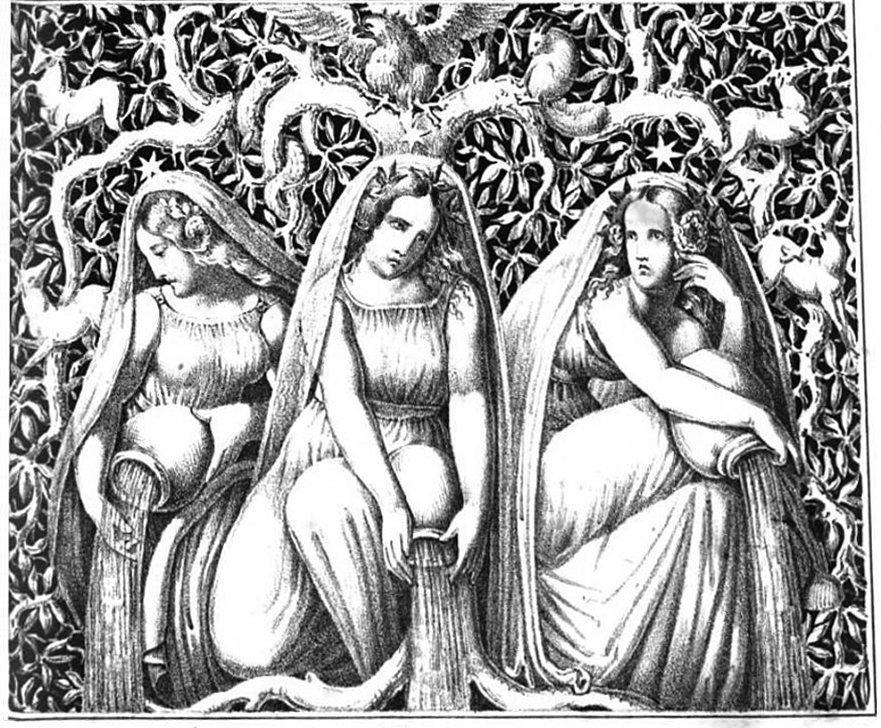
In Norse mythology, the Norns (pronounced like “norms” with an “n” instead of the “m”; Old Norse Nornir) are three female divine beings who have more influence over the course of destiny than any other beings in the cosmos. They dwell within the Well of Urd beneath Yggdrasil, the great ash tree that stands at the center of the universe and holdsContinue reading “N is for Nornir”
M is for Mjölnir
Sindri then put iron on the hearth, and told Brokkr that, for this next working, they must be especially meticulous, for a mistake would be more costly than with the previous two projects. Loki immediately stung Brokkr’s eyelid, and the blood blocked the dwarf’s eye, preventing him from properly seeing his work. Sindri produced aContinue reading “M is for Mjölnir”
M is for Miðgarðr
Midgard (Old Norse Miðgarðr, Gothic midjungards, Old English middangeard, Old Saxon middilgard, Old High German mittilgart or mittangard, Proto-Germanic *meðjanagarðaz,[1][2] “Middle Enclosure”) is one of the Nine Worlds of Norse mythology and an important concept in the pre-Christian worldview of all of the Germanic peoples. It’s the inhabited world, and roughly corresponds to the modern English word and concept of “civilization.” It’s the only one ofContinue reading “M is for Miðgarðr”
L is for Loki
Loki (pronounced “LOAK-ee;” Old Norse Loki . . .) is the wily trickster god of Norse mythology. –from Norse Mythology for Smart People by Daniel McCoy Loki is difficult to describe. He isn’t one of the Aesir, but he gets lumped with them because of his association with Odin, especially in the tales where Odin, Hoenir, and Loki travel together. AtContinue reading “L is for Loki”
K is for Kvasir
At the conclusion of the Aesir-Vanir War, the Aesir and Vanir gods and goddesses sealed their truce by spitting into a great vat. From their spittle they formed a being whom they named Kvasir (“Fermented Berry Juice”[1]). Kvasir was the wisest human that had ever lived; none were able to present him with a question for which he didn’t have a satisfyingContinue reading “K is for Kvasir”
J is for Jötunheim
Jotunheim (pronounced “YO-tun-hame;” Old Norse Jötunheimr, “World of the Giants”) is one of the Nine Worlds, and, as the name implies, the homeland of the giants (Old Norse jötnar). –from Norse Mythology for Smart People by Daniel McCoy Ragnarok began/will begin when the giants invade Asgard, home of the gods. For this reason, the gods take every precaution, including stationing Heimdall atContinue reading “J is for Jötunheim”
 sandrayeaman.com